This is a blog with spoiler free reviews. Most will be Fantasy, Science Fiction, and Horror, but there will be some books in other genres, including the occasional Non-Fiction review. There is an ongoing series of Cover Reveal Round-Ups, and sometimes I'll write an article on something that interests me.
Showing posts with label Hodder. Show all posts

26 July, 2013

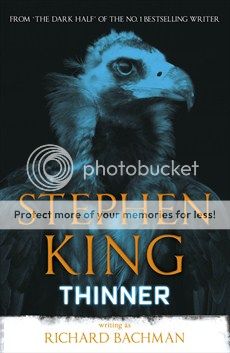
REVIEW: THINNER

Cover photo by Ilona Wellmann/Arcangel Images

THINNER
BY
STEPHEN KING
WRITING AS
RICHARD BACHMAN

ISBN: 978-1-444-72355-7
Pages: 340
Publisher: Hodder
First published: November 1984
This edition published: 20 December 2012

On the cover:

'Thinner' - the old gypsy man barely whispers the word. Billy feels the touch of a withered hand on his cheek.

Billy Halleck, prosperous if overweight citizen, happily married, shuddered then turned angrily away. The old woman's death had been none of his fault. The courts had cleared him. She'd just stumbled in front of his car. Now he simply wanted to forget the whole messy business.

Later, when the scales told him he was losing weight, it was what the doctor ordered. His wife was pleased - as she should have been. But . . .

'Thinner' - the word, the old man's curse, has lodged in Billy's mind like a fattening worm, eating at his flesh, at his reason. And with his despair, comes violence.


   When reading any of King's Bachman books I'm struck by two things. The first is how easy it is to see that King wrote this, and how strange it is that it wasn't discovered at once. Of course that is pretty much hindsight, and it does take a coincidence (or a tweet) for someone who is in a position to recognize a big name author's style to even be reading a no-name author's books.
   The second thing, and very much in connection to the first, is how many people have tried to copy King over the years. It's really not strange that anyone failed to notice Richard Bachman in the myriad of novels that have been published in the hopes of copying King's success.
    Of course there's a third thing... There was no internet when Bachman was publishing. No social media making it tempting for those that knew something to spill the beans.

   No internet would also have made it harder to discover an obvious huge flaw in this novel, "Gypsy" language. The language used in the book is actually Swedish. Not only that, it is atrociously bad Swedish. As someone who can remember when the number of TV channels available was tripled by the addition of two Swedish channels, I'm very familiar with Swedish.
   It goes without saying that seeing a familiar language being mangled on the page of a book is going to bring you out of it to some extent, but that is actually something I could live with. What I actually find worse is that the "Gypsies" do have their own language, Romani,  and it is substituted for a different one here.
   I completely understand that back in 1984, or perhaps a bit earlier, when this was written, King did not have access to the information he needed to use Romani in his book. And you know what, I have absolutely no problem with that. But being bi-lingual I do not like the idea of substitute languages. It's kind of offensive, it is in a way telling people that what their language is is not important. The only thing that matters is that it is "foreign".
   And it really is not hard to make it clear in the text that what is spoken is not English, even if you write it in English. Not that I think King should go back and change his book. As I started with, this was written in different times, and it should remain as it is as an artifact of that time.

   Thinner is a strange book, or not really considering it is King. It's pretty normal for King to write things that can be hard to classify neatly into a definitive genre category. Not that you'd notice that from all the people who state that King is a Horror writer.
   This is certainly leaning much more towards the Thriller side of the fence. While there certainly is a very central supernatural element making this Horror, that element almost exist as a separate state besides what else is going on in the story. And the other element of the story is absolutely a good one.

   As already mentioned this story has two different strands. The supernatural element is the one that we first get to hear about. Presenting it so quickly, without any build up at all, means that you very quickly get dragged into the story. It's very well done too, King hooks you right away and then he lets you simmer for a bit. And that is really my polite way of saying that after a very interesting opening the novel slows down quite a bit.
   This slow period is used for a bit of character development, especially of the main character William Halleck. Usually this is where King excels, in that he creates characters that you really care about, and that you really want to spend time with. There's nothing wrong with the "getting to know you" portion of this build-up period in this novel, it's just that the main character at first is not a very sympathetic person.
   You shouldn't actually take that as a complaint, it is an important part of Halleck's development. And in many ways it does strengthens the novel that the MC has more than one note to him.

   When the novel starts going again after the brief quiet period, it really gets going. This is where the Thriller part comes in to full effect. The structure gets very familiar to Thriller readers, as the story goes into a search mode. Familiar as this structure is, it is kept very interesting. There is some real tension to the narrative at this point. And this is ratched up quite a bit when a previously introduced character steps up to join a strong supporting role.
   There's a final confrontation that is really tense, and at times seems to be on the verge of dragging the novel into Action Thriller territory. It does get a nice resolution, although perhaps not a conventional one.
   The ultimate ending left me really ambivalent. Although there's a while since I read the novel I am still not wholly sure how I feel about it. It's certainly one I can see divide opinion.

   With relatively few characters, and a somewhat limited time frame, this almost has the feel of a shorter work. It feels pretty intimate, perhaps so than most of King's work.
   It's a good story that is executed very well, and it is certainly worth reading. Being pretty light on Horror this is a good place to start for those that have been scared off reading King by the impression of him belonging solely to that genre.
   For King fans this will of course be a must read, it is a good example of how King can write quality when he focuses on other plot points than the horror ones.


29 January, 2013

REVIEW: THE DEAD ZONE

Cover design by keenan
(NOTE: The cover I have has white background, not pink, but I couldn't find an image online that was not pink.)

THE DEAD ZONE
BY
STEPHEN KING

ISBN: 978-0-340-95268-9
Pages: 595
Publisher: Hodder & Stoughton
First published: 30 August 1979
This edition published: 2007

On the cover:

Meet Johnny Smith. A young man whose streak of luck ends dramatically in a major car crash. Followed by blackness. A long, long time in cold limbo.

When he wakes up life has been turned upside down. His fiancĂ©e has met someone else. And Johnny is cursed with the power to perceive evil in men's souls. He's had these hunches since he had an ice-skating accident as a child. Now he has an ability to see into the future. An ability which will bring him into a terrifying confrontation with a charismatic, power-hungry and dangerous man . . . 

*THIS REVIEW CONTAINS SOME SPOILERS*
   It's a daring move to start your novel with putting the main character in a coma. And in the case of this novel, it is a warning of what is to come.
   Usually with King's novels, you get really close to the characters, and it is this closeness that sets him apart from other writers of similar fiction. But here I never felt that. Sure, you do learn quite a bit of how Johnny Smith thinks, and functions, but we don't really see him actively taking part in events for most of the novel. This makes it hard to feel a connection to him related to what is actually happening. He is rarely close to events, and is not a proactive character.
    On top of that, I didn't feel like Johnny Smith was someone I'd like to hang out with. He's rather boring, and most of his interactions with others are on a superficial level.

   The novel suffers quite a bit because of its structure. We get to know quite a bit about characters who have no real impact on the story itself, and their place in Johnny's life is often more of a "could have been" than anything else. And it feels like a bit of a waste that so much space is used to get us to know these characters.
   King also introduces a whole serial-killer subplot that doesn't really go anywhere, even though Johnny is the one who solves the crime. We do get to see some scenes from the killers POV, but he is never a part of the book before he's caught. There's no real point/value to this subplot except to show Johnny's abilities, and the reader is already well aware of those. The reactions of the public to Johnny's involvement in solving the crime is not really explored deeply enough that I feel it warrants the inclusion of the subplot.
   Overall the plot feels a bit unstructured, set-ups don't pay off and pay-offs come when they have no previous set-up. It's all a bit too rambling for me.

   Not everything is wrong with this book, there's plenty of scenes that show how good King really is, and the premise is very interesting. The next to last chapter is also very good, and gives the novel an ending that is perhaps better than it deserves.
   This is a novel that is above average for its type, and if it had been written by any other author I would have rated it higher. But this is a Stephen King novel, and as such it falls short of what I have come to expect of him.
   For me this feels more like an experimental novel from King, it is one of his earlier ones, but it is an experiment that doesn't really work as well as it perhaps should. It doesn't really feel like a "proper" King novel should, and it totally lacks any Horror element.

   So far, this is the weakest King novel I have read. But although I have been quite critical of The Dead Zone, that shouldn't dissuade other readers. I have seen several people place it in their "top Stephen King novels of all time". So if you are a King fan who hasn't read it, you should perhaps seek out other opinions on this. Just because it didn't work for me doesn't mean it won't work for you, and I have absolutely no regrets that I read it.


26 July, 2012

THE LAND OF PAINTED CAVES

Cover art (Lions): Larry Rostant
Cover photo (hills): Irene Suchocki/Trevillion Pictures

THE LAND OF PAINTED CAVES
EARTH'S CHILDREN BOOK SIX
BY
JEAN M. AUEL

ISBN: 978-1-444-72057-0
Pages: 774
Publisher: Hodder/Hodder & Stoughton
First published: 29 March 2011
This edition published: 22 November 2012

On the cover:

 A STORY FROM THE BEGINNINGS OF OUR TIME

A remarkable woman - a huntress and healer who challenges every rule, but who yearns for acceptance.

Ayla lost her own people when she was a child. In the harsh landscape of the Ice Age, where to be alone is the greatest threat, her life has been a fight for survival - and a search for belonging.

But Ayla has an overwhelming sense of destiny that pulls against the needs of her heart. She hungers for knowledge and experience of the world. And what she learns will change life forever.

   This is the final volume in the story of Ayla. And as a enjoyed the previous ones I was really looking forward to see how her story was going to end. Unfortunately I was left rather disappointed.
   Auel is very good at telling the history of the people of the Stone Age/Ice Age, and it was my interest in history that brought me too these books in the first place. And that aspect of the novel works very well, you get quite a good insight into daily life in the period it's set, and there's no doubt that much of it is at the very least plausible.
   Before I go into specifics, I think I should mention that reviewing books has made me a more critical reader, and I may not have felt that the book had as much problems if I had been reading this before I started reviewing.

   The central story is in itself an interesting one, Ayla is taken in a direction that means we get closer to certain aspects of Stone Age life, but there's not really enough story in this journey to fill all the pages of this book. -And it shows.
   There is a lot of infodumping here, and while much of it has to do with Stone Age life and is quite interesting in itself, it breaks up the narrative. It can even be confusing at times as to where the non-fiction description in the narrative starts and begins. Personally I would have preferred this to be separated out with footnotes that referred to an appendix at the back of the book.
   In itself these non-fiction passages wouldn't have bothered me much, but there's lots of other small things that slow down the narrative and seems unnecessary.

   Repetition is a problem, we are told the same thing several times. This got on my nerves quite often, and it seemed like Auel was trying to hammer home things that were clear the first time. There is also much repetition of what has happened in the previous volumes, and even though it's more than five years since I read those I felt it was way too many reminders. Some of them where even repeated.
   Further repetition is made in the story itself. There are elements, that while happening at different times and locations, are very much alike. These come while Ayla is travelling, something that I felt was the strength of the previous volumes, but just didn't work here due to there being very little new on the journey.

   This novel isn't all bad. Despite the problems I have outlined above, there is really much that is good here. Auel still tells a very interesting story centered on Stone Age society, and the history is really fascinating. There is no doubt that Auel has done her research, and although it does shine through too much, it is really good to see a story that really feels like it could be a story from the time it is set in.
   The delving deeper into shamanism is also done very well, and it makes for the most interesting part of the book - and also what feels the freshest.

   I had some trouble with the ending of the book. It just didn't feel like a satisfying end to the story of Ayla, and it felt a bit abrupt.
   But to be fair, it was good to read about Ayla, Jondalar, and all the others again. And I do think that those who have liked this series so far will find it a good read despite its shortcomings. I know I am glad I read it, and I in no way wish I had refrained from reading this novel.
   This is a flawed finish to the Earth's Children series, but it is well worth reading anyway. Other readers may not find what I have mentioned as distracting as I did. And for those who have an interest in Stone Age history I would say the series as a whole is essential reading.

LINKS: Jean M. Auel  Hodder & Stoughton