This is a blog with spoiler free reviews. Most will be Fantasy, Science Fiction, and Horror, but there will be some books in other genres, including the occasional Non-Fiction review. There is an ongoing series of Cover Reveal Round-Ups, and sometimes I'll write an article on something that interests me.
Showing posts with label Tor Books. Show all posts

14 October, 2013

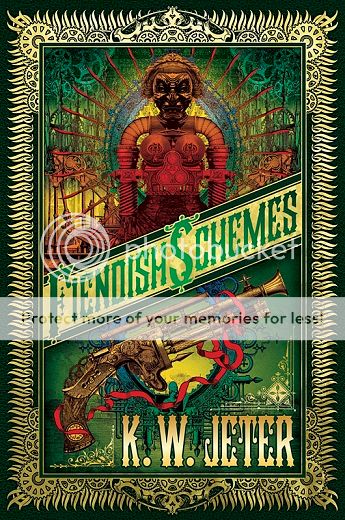
REVIEW: FIENDISH SCHEMES

Cover by John Coulthart

FIENDISH SCHEMES
(INFERNAL DEVICES 2)
BY
K.W. JETER

ISBN: 978-0-76537-402-8
Pages: 350
Publisher: Tor Books
Published: 15 October 2013

On the cover:
(Taken from the publisher's website.)

The world Dower left when he went into hiding was significantly simpler than the new, steam-powered Victorian London, a mad whirl of civilization filled with gadgets and gears in the least expected places. After accepting congratulations for his late father's grandest invention—a walking, steam-powered lighthouse—Dower is enticed by the prospect of financial gain into a web of intrigue with ominously mysterious players who have nefarious plans of which he can only guess.

If he can locate and make his father’s Vox Universalis work as it was intended, his future, he is promised, is assured. But his efforts are confounded by the strange Vicar Stonebrake, who promises him aid, but is more interested in converting sentient whales to Christianity—and making money—than in helping George. Drugged, arrested, and interrogated by men, women, and the steam-powered Prime Minister, Dower is trapped in a maelstrom of secrets, corruption, and schemes that threaten to drown him in the chaos of this mad new world.


   This is the sequel to Jeter's 1987 novel Infernal Devices (review). This book doesn't follow directly on from the previous one though, so you can jump straight to this one without a problem.

   Jeter is perhaps best known for inventing the term Steampunk, and this novel quickly shows it belongs to that genre by introducing a pretty fantastic steam-driven contraption very early on. Mind you, we are talking the original style of Steampunk here, there's a complete lack of werewolves or vampires.
   This story is firmly set in Victorian times, but not the rose-coloured version that we see in some modern Steampunk. Jeter's alternate 19th century Britain is a much darker place than that. There's room in this novel for the darker sides of industrial progress, and it doesn't ignore the plights of the working classes. This makes for a realistic alternate historical setting, at least when it comes to the societal side of things.

   While the setting is socially realistic, Jeter chooses to stretch things a bit beyond realism in some of the technology, and especially in this technology's interaction with humans. This is where the novel in some ways leaves Steampunk and veers into Weird Fantasy territory. Not that the former is ever gone from the novel, the latter is added to it.
   The weirdness of some aspects of the setting is something that really stuck with me, there are some really bonkers ideas in here. It does require a bit more of the reader to accept the weird things in this novel than perhaps is usual in Steampunk. But to me that is really a strength.
   Jeter's alternate Victorian London is in many ways an alien place, there's more than "window-dressing" that makes this London different to our London. The "steam" is much more integrated here than is usual, and the changes it has caused are huge. The technology also has effected the setting in a really significant way. All of which are done well, and in my opinion are significant strengths in this book.

   There is more to good Alternate History than just having a good setting. Without a story to back that up you are left with nothing much more than a technical manual. The story here is a very interesting one, and it makes great use of the world it is set in. The Weird Fantasy aspect of the novel is certainly present in the story as well as in the technology. It doesn't take long before we are introduced to concepts that requires a bit of outside the box thinking.
    The weirdness is also a reason why it's near impossible to predict what comes next in the story. After being introduced to a plot early on, the reader more or less just has to try to keep up with the twists and turns of the narrative. This is actually a great strength of the story. Unpredictability is a watchword here, and not knowing what happens on the next turn of a page is part of what makes this a very compelling read. It's not the only thing though, it really is a fascinating story for those that can handle all the weirdness.
   Our guide through this story, George Dower, is very much the person at the centre of events. Very little happens without him present, or him hearing about it. The latter is because Dower is the only viewpoint character of the story. This works very well on the story level, and adds a certain amount of suspense by not letting us know anything outside of what Dower himself is either experiencing, or is aware of. It is also a style choice that can make this book a bit of a hit or miss experience.

   Jeter has written this novel in a very distinct style, one that is also there in Infernal Devices. It takes some getting used to, as it is a step away from how modern SFF books are usually written. The style here is very Victorian in feel, something that I suppose could make the book feel old-fashioned. I however think it adds quite a lot to the atmosphere of the novel. The first person perspective becomes very close to what is happening because it gives you the feeling of reading something that is part of that time - even though what you read about is definitely not part of something that happened in our reality at that time.
   But as I mentioned above this can be hit or miss. The first person perspective means that there is quite a lot that has to be related to Dower, and depending on your personal preferences these passages can become a bit too much. I had some problems with it at first, not because it was badly done but because it does make the novel feel slow at times. However, when I got into this style of writing - because this is a feature, not a bug - I stopped having any problems with them.
   When you do get into the style, and the story starts flowing, it becomes natural that you have some wordy passages that explain things to our protagonist. And I must say that in retrospect I not only thought this worked very well, but I can't really see how the same effect could be accomplished by doing it in any other way.

   Overall this a novel that is a great example of Steampunk as Alternate History, and the added Weird Fantasy aspects makes this feel very much fresh despite the old-fashioned style it is written in. Jeter gives us something quite different from what is expected from modern Steampunk, and this novel is all the better for that. It may not be the easiest book in the world to get into, but when you do it does reward you for the slight effort.
   This is a thrilling ride into a very strange Steampunk world, and I would heartily recommend this to anyone who likes either Steampunk or Weird Fantasy. Jeter shows he is still a master of the SFF subgenre whose name he coined,
  

NOTE: I got an e-ARC of this book from the publisher/NetGalley.


26 March, 2012

REVIEW: GANYMEDE

Cover art: Jon Foster

GANYMEDE
A CLOCKWORK CENTURY NOVEL/
CLOCKWORK CENTURY BOOK THREE
BY
CHERIE PRIEST

ISBN: 978-0-7653-2946-2
Pages: 346
Publisher: Tor
Published: 27 September 2011

On the cover:

The air pirate Andan Cly is going straight. Well, straighter. Although he’s happy to run alcohol guns wherever the money’s good, he doesn’t think the world needs more sap, or its increasingly ugly side effects. But going straight is easier said than done, and Cly’s first legal gig—a supply run for the Seattle Underground—will be paid for by sap money.
   New Orleans is not Cly’s first pick for a shopping run. He loved the Big Easy once, back when he also loved a beautiful mixed-race prostitute named Josephine Early—but that was a decade ago, and he hasn’t looked back since. He's still on Jo's mind, though, or so he learns when he gets a telegram about a peculiar piloting job. It’s a chance to complete two lucrative jobs at once, one he can’t refuse. He sends his old paramour a note and heads for New Orleans, with no idea of what he’s in for—or what she wants him to fly.
   But he won’t be flying. Not exactly. Hidden at the bottom of Lake Pontchartrain lurks an astonishing war machine, an immense submersible called the Ganymede. This prototype could end the war, if only anyone had the faintest idea of how to operate it…. If only they could sneak it past the Southern forces at the mouth of the Mississippi River… If only it hadn’t killed most of the men who’d ever set foot inside it. 
   But it’s those “if onlys” that will decide whether Cly and his crew will end up in the history books, or at the bottom of the ocean.

   Like the second Clockwork Century book, Dreadnought, this also gives us a new location for the story. But this time we are much more tied to Boneshaker, the first book, through the re-appearing characters.
   There's two main characters this time, Adnan Cly who we met in Boneshaker and Josephine Early, who is new to the series. Early is a fascinating woman, and her "boarding house" in New Orleans provides a great setting to show off a side of society we rarely see detailed in SFF. 
   The supporting cast are also interesting in their own right, there's not a feeling of them being there just to "fill in the scenery" of the story. That some of them are returning from the previous books is also welcome, and it gives the novel a great connection to the Clockwork Century series as a whole.

   New Orleans is a great setting for the story, and it also provides some very interesting insights into what is changed from our history in Priest's books.
   What has happened to New Orleans in this timeline's history is central to the story of this novel. And I found the revelations of the greater events that have shaped the New Orleans we see very interesting. The Alternate History of The Clockwork Century continues to be added to, and I think the historical backdrop shows off the strength of Priest's worldbuilding skill.
   The novel is by no means confined to the Alternate History genre, there is much more going on here that comes from other SFF subgenres, but I must say that I enjoy immensely seeing Priest give us greater and greater understanding of the larger world as the series progresses.

   The story this time has a great deal of suspense to it, as well as some nice action scenes. The New Orleans and surrounds setting gives a nice backdrop to a story that while completely in line with The Clockwork Century as a whole, has a very distinct feel to it. Josephine Early works as a great centre for the events depicted and her personal story adds depth to the novel.
   Events move at a pretty fast pace, but never at the expense of substance. There are some great references to our history here that I think will be nice "Easter eggs" for those who are interested in history.

   The way the story manages to mix the suspense, action, and worldbuilding makes for an excellent read. This novel really cements Priest's place at the forefront of the current Alternate History/Steampunk wave. She writes an excellent mix of Alternate History, Steampunk, and adventure novel that deserves to be widely read. If you are not familiar with this series, I urge you to pick it up the next time you shop for books.


22 March, 2012

REVIEW: DREADNOUGHT

Cover art: Jon Foster
Cover design: Jamie Stafford-Hill

DREADNOUGHT
A CLOCKWORK CENTURY NOVEL/
CLOCKWORK CENTURY BOOK 2
BY
CHERIE PRIEST

ISBN: 978-0-7653-2578-5
Pages: 400
Publisher: Tor
Published: 28 September 2010


On the cover:

Mercy Lynch is working at a war hospital in Richmond, Virginia, when she learns that her husband has died in a POW camp and her estranged father is gravely injured and wishes to see her. With no good reason to stay in Virginia, Mercy sets out to see her father in Seattle.
   But crossing the country is no small task; it's a harrowing adventure through war-torn border states by dirigible, rail, and the Mississippi River. And once Mercy arrives in St. Louis, the only Tacoma-bound train is pulled by a terrifying Union-operated steam engine called the Dreadnought. Lacking options and running out of money, Mercy buys a ticket and climbs aboard.
   What ought to be a quiet trip turns deadly when the train is beset by bushwackers, then vigorously attacked by a band of Rebel soldiers. The train is moving away from battle lines into the vast, unincorporated west, so Mercy can't imagine why it's meeting such resistance. Perhaps it has something to do with the mysterious cargo in the second and last train cars?
   Mercy is just a frustrated nurse who wants to see her father before he dies. But she'll have to survive both Union intrigue and Confederate opposition if she wants to make it of the Dreadnought alive.

   This novel is set shortly after the events in Boneshaker. It is not however set in Seattle, and the main character here, Mercy Lynch, was not in the first book. She is however related to the events of the first book in a way that will become clear to the reader pretty early on.
   It's not exactly common to move the location and change the characters in the middle of a series, and some people may be disappointed by not having another novel with the characters they grew to love in the last volume. I didn't find it a problem at all, instead I found it one of the strengths of the book.
   Last time around we had some references to other events in Priest's Alternate History, and this time we get to go closer to them and find out more about how the rest of the USA is affected by this alternative timeline. I am a fan of Alternate History and I must say that Priest has managed to expand on that part of the novel here, and she does it very well. Now that there is more information of the larger world of The Clockwork Century, it feels even more alive and realistic. This would actually work without the Steampunk and supernatural element. And because of that I think Alternative History fans would find this novel very interesting.

   The Steampunk elements of the novel really stand out. Especially one set of machines that we encounter early on are absolutely marvelously "mad professor" bonkers. And by bonkers I mean totally jawdroppingly cool. They are not alone, there are dirigibles, and the titular Dreadnought that is also a great invention fitting to an age of steam.
   What interested me is that there are mentions of machines being run on diesel here. It seems to be a very natural progression in the technology, something that strengthens the believability of the world in my eyes.

   Mercy Lynch is our "guide" through the world Priest has created, it is through her that we experience the events in Dreadnought. She is a great character to follow, and we quickly learn enough about her that we can see get a good understanding of who she is. As we follow her journey we get even more insights into her, she comes off as both interesting and a realistic product of the world she inhabits.
   There are several other characters in the supporting cast that we also get a more than a brief insight into. And Priest manages to make them all interesting, the whole ensemble is put together in such a way that they enhance the story. Priest is very good at making the characters feel like people who happen to be caught up in the events and they do not come off as being constructed to advance the story.

   The story takes us on a journey across the continent from west to east. It has a certain road trip feeling to it but at the same time we see developments of what seems to be an over arcing theme that connects the Clockwork Century novels.
   There is a lot of action in this story, it never gets boring. Of course there are quiet patches, but these are put into good use to make the plot come more alive. The central plot is Mercy's journey across America, a journey we know where is supposed to end. But there is also a hidden purpose to the train journey Mercy becomes a part of, one that becomes a mystery to be solved by her and by extension the reader.
   I really liked the atmosphere of the novel, the mystery and the physical journey combined to create a tension that drove me to read on. Although the mystery was not that hard to figure out, it did have a huge part in making the plot to work much better. The characters actions were made much more plausible by them being unaware of the greater purpose of the journey. And there were parts of what was going on that was unexpected to me and made the suspense greater.

   In total this was a great read, the parts came together seamlessly to make a whole that was both interesting and exciting. The action and suspense makes it a quick read, and the underlying framework of the world combined with well realised characters makes it a very interesting novel. It works well as a standalone novel, but having read Boneshaker will give it a few more layers that strengthens it.
   The Steampunk elements will appeal to the fans of that genre, and the Alternate History of the US Civil War will be satisfying to fans of that genre. And anyone who likes action and adventure set in the past should give this novel a try.

Review: Boneshaker

Links: Cherie Priest  Tor/Forge  Tor/Forge Blog

03 February, 2012

REVIEW: BONESHAKER

Cover art: Jon Foster
Cover design: Jamie Stafford-Hill

BONESHAKER
A CLOCKWORK CENTURY NOVEL/
CLOCKWORK CENTURY BOOK 1
BY
CHERIE PRIEST

ISBN: 978-0-7653-1841-1
Pages: 414
Publisher: Tor
Published: September 2009


On the cover:

   In the early days of the Civil War, rumors of gold in the frozen Klondike brought hordes of newcomers to the Pacific Northwest. Anxious to compete, Russian prospectors commissioned inventor Leviticus Blue to create a great machine that could mine through Alaska’s ice. Thus was Dr. Blue’s Incredible Bone-Shaking Drill Engine born.
    But on its first test run the Boneshaker went terribly awry, destroying several blocks of downtown Seattle and unearthing a subterranean vein of blight gas that turned anyone who breathed it into the living dead.
    Now it is sixteen years later, and a wall has been built to enclose the devastated and toxic city. Just beyond it lives Blue’s widow, Briar Wilkes. Life is hard with a ruined reputation and a teenage boy to support, but she and Ezekiel are managing. Until Ezekiel undertakes a secret crusade to rewrite history.
    His quest will take him under the wall and into a city teeming with ravenous undead, air pirates, criminal overlords, and heavily armed refugees. And only Briar can bring him out alive.


   Wow! Are you actually allowed to write Steampunk that isn't set in Victorian London? Kidding aside, it is actually refreshing to see some Steampunk that isn't set in London for a change. The location here is Seattle, Washington (State), USA. A city that Priest manages to make come alive very well in her novel.

   I really like the way the book opens with an "excerpt from a history book" prologue. It means there isn't the need for so much infodumping at the beginning of the book, and it also helps place the story in its historical context.
   The story itself opens relatively slow, but gives us a great introduction to Briar Wilkes and her son Zeke. Both of them are interesting characters in their own right, and Priest early on makes it clear what kind of relationship they have, something that serves to make both of them both more sympathetic and relatable.

   Priest is good at building up to the action with a look at the world in which the story is set. When things "really" start to happen, you are already well aware of the local environment. And there is enough information to get a good idea of what the status is within the larger world of this Alternate History world.

   There's quite a bit of action in this book. Priest writes very good action scenes, and she doesn't let the action overpower the storyline. They come more as an added bonus to what is already a suspenseful story.
   Much of the suspense in the novel comes from the setting and the atmosphere it provides. There is a constant sense of the characters being isolated, moth literally and figuratively. And this works very well, you understand the sense of dread that the characters feel and Priest's prose draws you into it.

   Along with writing a suspense-, and action-filled novel, Priest has also managed to find room for a couple of rather big mysteries. And she manages to delay the revelations of them for a long time without it becoming annoying , and when she eventually gives us the answers they are worth the wait.

   What made me most happy about finishing this book is knowing that there are more novels in this series that I can move on to, and I really look forward to doing that.
   This is a very good novel, it works great both for Steampunk and Alternate History fans, and I don't think Survival Horror fans will go away disappointed if they try it out either.
   A book I don't hesitate to recommend to anyone that likes a good adventure set in a vivid and realistic world. And a great introduction to Steampunk for those that haven't tried that  out yet.

Links: Cherie Priest  Tor/Forge  Tor/Forge Blog

26 February, 2011

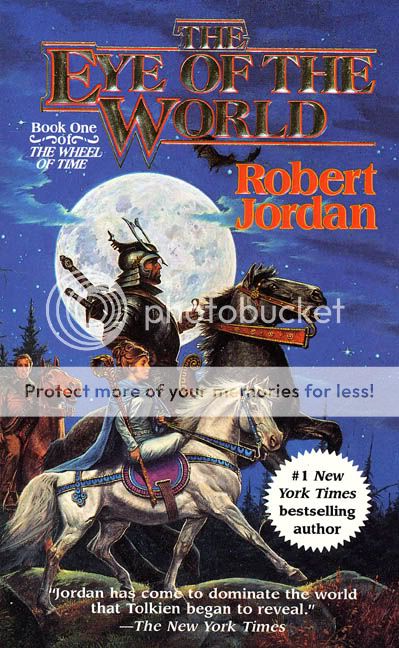
REVIEW: THE EYE OF THE WORLD

Cover Art: Darrell K. Sweet

THE EYE OF THE WORLD
THE WHEEL OF TIME BOOK 1
BY
ROBERT JORDAN

   ISBN: 978-0-8125-1181-9
Pages: 782
Publisher: Tor
Publishing date: 15 January 1990

On the cover:

The Wheel of Time turns, and Ages come and go. What was, what will be, what is, may yet fall under the Shadow. Let the Dragon ride again on the winds of time.

   NOTE: As you can read here this is the first time I've read this book. And I have not been following the series at all, so I basically know nothing about what comes later. So this review is written in the same way it would be if it was the only Wheel of Time book in existence.

   Let's begin with the obvious, Jordan steals/borrows heavily from J.R.R. Tolkien's The Lord of the Rings. Not just the formula, but characters, locations, monsters and events are more or less carbon-copies from TLoTR.
   I don't mind the occasional nod to other works, but here it is not so much nods as a barrage of headbutts. It was in fact so much of it, that I found it really annoying. Especially since this has been done before by Terry Brooks in The Sword of Shannara (1977) and Margaret Weiss & Tracy Hickman in The Dragonlance Chronicles (1984/1985). There's also one character that has some striking similarities to a character from Stephen Donaldson's The Chronicles of Thomas Covenant (First and Second Chronicles 1977-1983, sorry I don't remember which book).
   So the level of originality in this book is pretty low. So if you expect that, this is certainly not the book for you. -But let's move on.

   The worldbuilding seems a bit lacking. There's several things that just don't seem to add up in the kingdom that most of Eye of the World is set in. What I reacted to most, was the political side of things.
   There's a sect that opposes the queen. Yet they have much more power in the capital, where there are plenty of "Queen's guards", and next to no power in the outlaying districts of the kingdom where the queen has no presence that we hear about. Add to that the fact that these outlaying districts is far closer to the power-base of the sect, it made little sense to me. And it totally lacks any explanation in the story.
   It seems that there is not much real worldbuilding at all, and that the world is just thrown together to fit with what is needed for the plot. Making it inconsistent, and neither believable nor logical to me.

   There's nothing wrong with the story itself, although it is a "light" fantasy done after a formula. Jordan has embraced the tendency of epic fantasy to go into descriptive mode. Unfortunately he does this way too much, and inconsistently. There were lots of detailed descriptions of what I found to be uninteresting things. But when it came to some of the cities, where a description could have added to the understanding of culture and thereby the worldbuilding, he chooses to give only a fleeting description. Something that was disappointing to me.

   The pacing of the book was rather slow. The endless description dragged it down, and there is really not a lot happening. There were several times when the book picked up the pace, but these ended quickly, and it was back to the plodding along.
   Overall the book gave you the feeling of being stuck in traffic. Every time it started moving forward a bit, and I got hopeful that things were going forward, it clogged up again and ground to a halt.

   There are several other things that I think is wrong with this book that I could mention, but there is no real reason for me to go on.
   I wouldn't really recommend this book if you want to read epic fantasy, there are lots of books out there that are much better. But if you loved The Lord of the Rings, and miss fantasy that evokes memories of it, this would be a perfect book for you.

See also Malazan Book of the Fallen vs The Wheel of Time

LINKS: Dragonmount (Wheel of Time community)  Tor Books

01 November, 2010

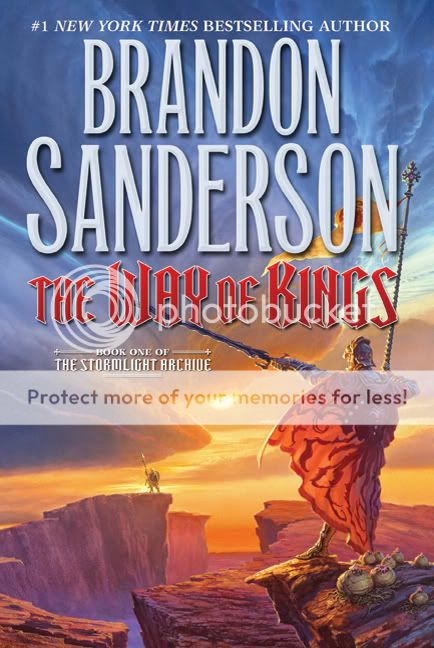
REVIEW: THE WAY OF KINGS

Cover illustration: Michael Whelan

THE WAY OF KINGS
THE STORMLIGHT ARCHIVE BOOK 1
BY
BRANDON SANDERSON

ISBN: 978-0-7653-2635-3
Pages: 1008
Publisher: Tor Books
Publishing date: 31 August 2010


On the cover:

Roshar is a world of stone and storms. Uncanny tempests of incredible power sweep across the rocky terrain so frequently that they have shaped ecology and civilization alike. Animals hide in shells, trees pull in branches, and grass retracts into the soilless ground. Cities are built only where the topography offers shelter.

It has been centuries since the fall of the ten consecrated orders known as the Knights Radiant, but their Shardblades and Shardplate remain: mystical swords and suits of armor that transform ordinary men into near-invincible warriors. Men trade kingdoms for Shardblades. Wars were fought for them, and won by them.

One such war rages on a ruined landscape called the Shattered Plains. There, Kaladin, who traded his medical apprenticeship for a spear to protect his little brother, has been reduced to slavery. In a war that makes no sense, where ten armies fight separately against a single foe, he struggles to save his men and to fathom the leaders who consider them expendable.

Brightlord Dalinar Kholin commands one of those other armies. Like his brother, the late king, he is fascinated by an ancient text called The Way of Kings. Troubled by over-powering visions of ancient times and the Knights Radiant, he has begun to doubt his own sanity.

Across the ocean, an untried young woman named Shallan seeks to train under an eminent scholar and notorious heretic, Dalinar’s niece, Jasnah. Though she genuinely loves learning, Shallan’s motives are less than pure. As she plans a daring theft, her research for Jasnah hints at secrets of the Knights Radiant and the true cause of the war.

The result of over ten years of planning, writing, and world-building, The Way of Kings is but the opening movement of the Stormlight Archive, a bold masterpiece in the making.

Speak again the ancient oaths,

Life before death.
Strength before weakness.
Journey before Destination.

and return to men the Shards they once bore.

The Knights Radiant must stand again.

    This is true Epic Fantasy, this being the first of an announced ten books. I'm a fan of long series when it comes to both Fantasy and Science Fiction, I like to get to really know the characters and follow them over a longer period of time. (There's one exception, but I will not use the G-word in my blog.)
    Of course first impressions are important when starting a long series of books, especially when they are the size of The Way of Kings. And Sanderson gets it right, there is much to love here.

    After reading the prelude and the prologue, I was already drawn in to this world and wanted to know more. And as the book progresses the world opens up, and it is an intriguing world.
    We follow three main characters on their different journeys, this is done in such a way that the changes of viewpoint keeps you reading without being annoyed with waiting for a individual story-thread to continue.

    The individual characters are different enough to add a lot to the reader's understanding of the world, and each gives a glimpse into different aspects of it. The world building is great, there are lots of little details that really fleshes out the setting. And we are given some tantalizing glimpses of how wast this world really is. It looks like this could be one of the largest Fantasy worlds ever. And I hope it will be as interesting as this first book makes it out to be.

    We get stories set into the war-torn wasteland, and in one of the larger cities. There is not much of a quest aspect to the story, but that is a strength here. The choice Sanderson has made in setting the story mostly in fixed locations means that the reader does not have to struggle with too large amounts of information.
    There is enough action here to satisfy most people. And at the same time we get a lot of back story that is very interesting without making the pace drag. Almost everyone should be satisfied with the complexity of the story, and also it's ease of access.

    This is the first book I have read by Sanderson, and I really liked his writing. I found it fit the type of story very well. It is still early days for The Stormlight Archives, but this could very well turn out to be one of the best Fantasy series ever.

NOTE: This review is based on an ARC of the book that I won from Tor Books.


LINKS: Brandon Sanderson  Tor Books