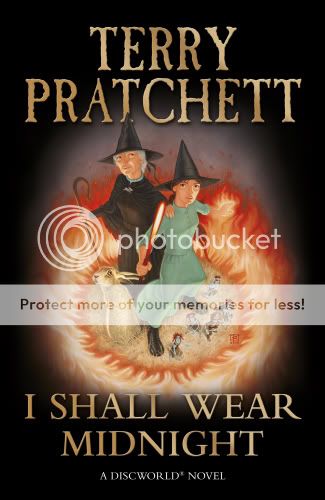
Cover art: Paul Kidby
Cover design and image manipulation: Claire Ward
RAISING STEAM
DISCWORLD BOOK 40
MOIST VON LIPWIG BOOK 3
BY
TERRY PRATCHETT
ISBN: 978-0-857-52227-6
Pages: 374
Publisher: Doubleday (Transworld Publishers)
Published: 7 November 2013
On the cover:
To the consternation of the patrician, Lord Vetinari, a new invention has arrived in Ankh-Morpork – a great clanging monster of a machine that harnesses the power of all of the elements: earth, air, fire and water. This being Ankh-Morpork, it's soon drawing astonished crowds, some of whom caught the zeitgeist early and arrive armed with notepads and very sensible rainwear.
Moist von Lipwig is not a man who enjoys hard work. As master of the Post Office, the Mint and the Royal Bank his input is, of course, vital... but largely dependent on words, which are fortunately not very heavy and don't always need greasing. However, he does enjoy being alive, which makes a new job offer from Vetinari hard to refuse.
Steam is rising over Discworld, driven by Mister Simnel, the man wi' t'flat cap and sliding rule who has an interesting arrangement with the sine and cosine. Moist will have to grapple with gallons of grease, goblins, a fat controller with a history of throwing employees down the stairs and some very angry dwarfs if he's going to stop it all going off the rails...
Discworld has in many ways become the gateway to SFF for many people in the last 30 years, but it has changed quite a bit over the years. It has moved a long way from the parody of the first two books, but you can still see the seeds that lead to this fortieth volume in those books.
As usual this is a standalone, but I would say that it makes much more sense as the third of the, series-within-a-series, Moist von Lipwig books. And I would advice anyone who isn't planning to read this only because they love (steam) trains to start at the first of those books, Going Postal.
There's so many elements here, like Commander Vimes and Lord Vetinari, that come with all the baggage from earlier books, that actually reading this on its own would lessen the readers experience to a significant extent in my opinion. And that is also something I see as a problem for the later Discworld books in general, it has become much more of a series than it was. In fact it seems to be almost taken over by Commander Vimes, a character whose story really should have ended with 2002's Night Watch, and he crops up again in a much too big role here.
Well, that is a bit of context, on to the review of this novel:
It's obvious that this story is about steam power, or the railway...Except that is only one of three story threads here. There is one about how the goblins, golems, and other such creatures fit into life on the Discworld now that they have gotten recognition. That one is pretty slight here, and is something that has being going on in Discworld books for a long time. We get a bit more of it here, and it works well as an update into an ongoing concern. But as I wrote about in the previous paragraph, this is another of the elements that has a lot of previous history to it. Although to be fair, this one works pretty well without familiarity with previous Discworld books.
The second storyline concerns the dwarfs, specifically the conflicts between the orthodox members of the species and those that are open to change. This ties in very much with the railway, that stands as a symbol for progress. And they sort of fit together nicely. I say sort of, there's a problem with the dwarf part being its own thing. For that part of the story the railway is incidental, and it could have been anything. In fact, as it turns out in the end, it's something a bit more important than technical progress that is at the heart of the dwarf side of things. And I feel that this whole side of the story could have been better served by giving it a whole book of its own. Preferably one that wasn't hampered by having a previous leading character at the centre. I just think this story thread has more importance than being relegated to being one of two plot threads gives it.
That being said, this is actually a really good story. Pacing-wise it is a really fast one, at times reminiscent of an Action Thriller. There is a lot happening, the book is really bursting at the seams with story. (Which can be a problem, as I have already mentioned.) Pratchett has put in quite a bit of good action scenes here, and there s some suspense involved. Although to be fair, it's mostly suspense as to how things are going to happen instead of what is going to happen. It does really pull you along towards the end though. I read to the end through the night, and finished in the morning, I didn't really want to put this down before I'd turned the last page.
There is a nice build to this story. It starts out rather slow, introducing the railway and the players behind it. Once it gets going though there's a crescendo like building in the events surrounding this new technology. This is done extremely well, and it puts up a very good mirror to our world in that regard. Almost everyone reading the novel can remember events from their lifetime that happened in similar ways that the railways introduction to the Discworld. And as Pratchett has shown us many times before, he is very good at putting things in our world in perspective by using the Discworld.
Of course that isn't completely problem free. New inventions cropping up has became a sort of Discworld cliche. We saw it in Moving Pictures and Soul Music, and this is the third such outing for Moist van Lipwig. And to be perfectly frank it is starting to feel a bit stale. Mind you, it is still very well done.
On to the characters, the central one is Moist von Lipwig, a former con man who has become the man who fronts Ankh-Morpork’s forays into modernisation. I’ve liked him as a character before, and I still do to some extent, but he’s getting a bit stale. However, the problem here is that he isn’t really needed. You see, the characters of Dick Simnel, Harry King, and Lord Vetinari's secretary Drumknott actually fill all the needs of the story. They are certainly interesting people, but we only get a glimpse of that, because we have Moist von Lipwig running around doing stuff. Granted, he's a good person to go around giving the reader a glimpse of what's happening. But he's in some ways just fulfilling the role Rincewind had in the earlier books here by running around to show the reader things.
I already mentioned the problems I had with Commander Vimes showing up. And there is some sense here that he does so only because of his popularity, the same can be said for Lord Vetinari. But they do fulfill their roles when they show up, and so does the rest of the cast. There's just no real new character development here. Dick Simnel, who is very central, doesn't really get to be much more than a stereotypical mechanical inventor/tinkerer.
All of these characters are actually good, they just lack the depth we have gotten from Pratchett's characters before. They are really more like scenery to the story here, so well drawn and complex characters aren't really this books strength. With something of an exception for the Low King of the dwarf. But as the storyline of the dwarfs get a bit of a short shift here, so does their king. Hopefully we'll see more of the king's story at a later date.
As a summation, I'll say that this is very much what you'd come to expect from recent Discworld books. The laughs are mostly gone, but there's plenty of smiles. The story is good, and it talks about important issues and shows us our world in a new light. For those who have read Pratchett all along there is a certain disappointment about the lack of something new though. It's a bit stale, and at the same time it feels a bit like there's a rush to get to the "end point" of the Discworld's development before it's too late.
This is still a very good read though, and one I have no hesitation with recommending. Read it as a Steampunk-inventor novel building to a fast paced Action Thriller towards the end, and I think you will pretty much follow along with what the story is, in my opinion. The social commentary, and the mirroring of our world is still very well done, and is worth picking this up for if you like those kind of elements on your SFF.
All in all this is good Fantasy, that just lacks that little bit to make the grade into great.
REVIEWS: I Shall Wear Midnight The Long Earth
LINKS: Terry Pratchett Transworld Books