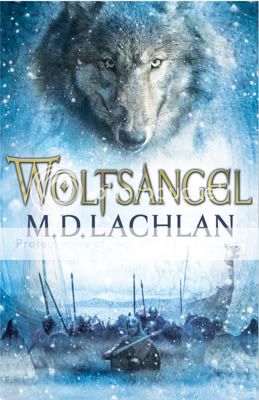
Cover art by Paul Young
Cover design by Patrick Knowles
LORD OF SLAUGHTER
BY
M.D. LACHLAN
ISBN: 978-0-575-08968-6
Pages: 403
Publisher: Gollancz
Published: 13 June 2012
On the cover:
Cover design by Patrick Knowles
LORD OF SLAUGHTER
BY
M.D. LACHLAN
ISBN: 978-0-575-08968-6
Pages: 403
Publisher: Gollancz
Published: 13 June 2012
On the cover:
On a battlefield strewn with corpses, a ragged figure, dressed in wolfskin and intent on death, slips past the guards into the tent of the Emperor and draws his sword.
The terrified citizens of Constantinople are plagued by mysterious sorcery. The wolves outside the city are howling. A young boy had traded the lives of his family for power. And a Christian scholar, fleeing with his pregnant wife from her enraged father, must track down the magic threatening his world.
All paths lead to the squalid and filthy prison deep below the city, where a man who believes he is a wolf lies chained, and the spirits of the dead are waking.
The Norsemen camped outside the city have their own legends, of the wolf who will kill the gods, but no true Christian could believe such a thing.
And yet it is clear to Loys that Ragnarok is coming. Will he be prepared to sacrifice his life, his position, his wife and his unborn child for a god he doesn't believe in?
And deep in the earth, the wolfman howls...
This is the third volume in Lachlan's series, following from Wolfsangel and Fenrir (link to reviews of both at bottom). It continues the theme of rebirth, and cycles that was also heavily present in Fenrir. Vikings are again playing an important part, but this time we have moved to Constantinople, or Miklagard as the Vikings would say.
The setting is a very interesting one, and Lachlan is very good at making it come alive. Unfortunately it is also the source of some disappointment to me. You see, the Varangian guard were the Viking elite soldiers of the Eastern Roman Emperor, and there is a lot of interesting history connected to them. And I expected that to be more prominent in the book.
Note the words "I expected" above, this isn't actually a flaw of the book. It's my expectations, based on my knowledge of history, making me want something the author actually did not put in his story. Normally I wouldn't mention something like that, I prefer to stick to reviewing what is actually in the book. And if we are honest, there is always something personal that colours how we interpret, and feel about, what we read. But in this case it did lead to me always waiting for something that never showed up while reading the story, and I wouldn't be honest if I said that didn't effect my enjoyment in a pretty direct way.
I could of course wait a couple of years, read this book again without my expectations, and then review it. But that is not really fair in my opinion, and it's not really something I do. I don't re-read to change my opinion. Instead I'll write this review giving the impression I got when I read it, with my assumptions in the background. Just be aware that when you read this, that if you know nothing of the Varangian guard, or the Vikings in Miklagard, you are likely to have a different experience.
I've mention that Lachlan makes the setting come alive, he also does a great job with the characters. They are very interesting in themselves, and they come very quickly to life when they are introduced. The whole build-up phase of the book, about the first half, is great. Everything is set up very nicely, but then it feels like the book does a big shift.
The shift goes from the story that has been built up, and the setting, to the greater story that this series is about, and for me that didn't really work. What is a great setting, and some great characters, are put on the back-burner to a much more magic/supernatural oriented story. And that makes it feel like all the good build-up that goes before it doesn't really count. From here on in the story could really be set anywhere and be told with any characters. And the strength of the previous book, Fenrir, is precisely that it feels like it has to be told exactly where it is with exactly those characters.
This is by no means to be taken as it is a bad story, because it isn't. Taken in isolation this is a very good story, whose only problem is that it has some repetition because one of the characters is discovering things that are already known to the reader.
Ordinarily that wouldn't really be an issue for me, especially when it is well done, like it is here. But this is book three of a cyclic story, and it feels too repetitive when we get that story rediscovered twice in the same volume. Because if you are like me, you will have read the two first books, and already be aware of it.
When trying to sum up my reaction to this, I'd say it was ambivalent. This is actually a good story, and there is no doubt that this shows that Lachlan is both a good writer and a good storyteller. But it's also got some of the typical diseases of the middle volume(s) of a Fantasy series, it's bogged down in it's own history, and starting to repeat itself.
As I said above, I also feel that the setting becomes too much of a background here. Some of that is because of the expectation I outlined at the beginning of this review, and some of it has to do with the story ending up somewhere that could be everywhere. Making the set-up, of both setting and characters, feel a bit wasted. And in so doing, the story also becomes repetitive, whereas with a setting affecting it, it would feel much fresher.
So, overall a good novel, but with some flaws that can make it hit or miss. I'd absolutely recommend someone who has interest in the Vikings and their mythology pick up this book. Reading the previous volume isn't essential.
For those that have read the previous volumes, if you have no problems with the repetitious nature of part of the story, you should enjoy this. But if you, like me, was hoping for another exploration into the Viking's journey around the world, then you may be disappointed.
REVIEWS: Wolfsangel Fenrir
LINKS: Gollancz Gollancz Blog
The setting is a very interesting one, and Lachlan is very good at making it come alive. Unfortunately it is also the source of some disappointment to me. You see, the Varangian guard were the Viking elite soldiers of the Eastern Roman Emperor, and there is a lot of interesting history connected to them. And I expected that to be more prominent in the book.
Note the words "I expected" above, this isn't actually a flaw of the book. It's my expectations, based on my knowledge of history, making me want something the author actually did not put in his story. Normally I wouldn't mention something like that, I prefer to stick to reviewing what is actually in the book. And if we are honest, there is always something personal that colours how we interpret, and feel about, what we read. But in this case it did lead to me always waiting for something that never showed up while reading the story, and I wouldn't be honest if I said that didn't effect my enjoyment in a pretty direct way.
I could of course wait a couple of years, read this book again without my expectations, and then review it. But that is not really fair in my opinion, and it's not really something I do. I don't re-read to change my opinion. Instead I'll write this review giving the impression I got when I read it, with my assumptions in the background. Just be aware that when you read this, that if you know nothing of the Varangian guard, or the Vikings in Miklagard, you are likely to have a different experience.
I've mention that Lachlan makes the setting come alive, he also does a great job with the characters. They are very interesting in themselves, and they come very quickly to life when they are introduced. The whole build-up phase of the book, about the first half, is great. Everything is set up very nicely, but then it feels like the book does a big shift.
The shift goes from the story that has been built up, and the setting, to the greater story that this series is about, and for me that didn't really work. What is a great setting, and some great characters, are put on the back-burner to a much more magic/supernatural oriented story. And that makes it feel like all the good build-up that goes before it doesn't really count. From here on in the story could really be set anywhere and be told with any characters. And the strength of the previous book, Fenrir, is precisely that it feels like it has to be told exactly where it is with exactly those characters.
This is by no means to be taken as it is a bad story, because it isn't. Taken in isolation this is a very good story, whose only problem is that it has some repetition because one of the characters is discovering things that are already known to the reader.
Ordinarily that wouldn't really be an issue for me, especially when it is well done, like it is here. But this is book three of a cyclic story, and it feels too repetitive when we get that story rediscovered twice in the same volume. Because if you are like me, you will have read the two first books, and already be aware of it.
When trying to sum up my reaction to this, I'd say it was ambivalent. This is actually a good story, and there is no doubt that this shows that Lachlan is both a good writer and a good storyteller. But it's also got some of the typical diseases of the middle volume(s) of a Fantasy series, it's bogged down in it's own history, and starting to repeat itself.
As I said above, I also feel that the setting becomes too much of a background here. Some of that is because of the expectation I outlined at the beginning of this review, and some of it has to do with the story ending up somewhere that could be everywhere. Making the set-up, of both setting and characters, feel a bit wasted. And in so doing, the story also becomes repetitive, whereas with a setting affecting it, it would feel much fresher.
So, overall a good novel, but with some flaws that can make it hit or miss. I'd absolutely recommend someone who has interest in the Vikings and their mythology pick up this book. Reading the previous volume isn't essential.
For those that have read the previous volumes, if you have no problems with the repetitious nature of part of the story, you should enjoy this. But if you, like me, was hoping for another exploration into the Viking's journey around the world, then you may be disappointed.
REVIEWS: Wolfsangel Fenrir
LINKS: Gollancz Gollancz Blog