This is a blog with spoiler free reviews. Most will be Fantasy, Science Fiction, and Horror, but there will be some books in other genres, including the occasional Non-Fiction review. There is an ongoing series of Cover Reveal Round-Ups, and sometimes I'll write an article on something that interests me.
Showing posts with label Gollancz. Show all posts

12 May, 2014

REVIEW: THE MAN IN THE HIGH CASTLE


THE MAN IN THE HIGH CASTLE
BY
PHILIP K. DICK

ISBN: 978-0-57508-205-2*
Pages: 248
Publisher: Gollancz
First published: October 1962
This edition published: [2001]*

On the cover:

(From the publisher's website.)

It is 1962 and the Second World War has been over for seventeen years: people have now had a chance to adjust to the new order. But it's not been easy. The Mediterranean has been drained to make farmland, the population of Africa has virtually been wiped out and America has been divided between the Nazis and the Japanese. In the neutral buffer zone that divides the two superpowers lives the man in the high castle, the author of an underground bestseller, a work of fiction that offers an alternative theory of world history in which the Axis powers didn't win the war. The novel is a rallying cry for all those who dream of overthrowing the occupiers. But could it be more than that?


   To start this review I have to address something that I haven't seen anybody else do, namely the racism of the text. I am not talking about the racism of the story, I am talking about the racism displayed by the author's choices in how he represents the Japanese in the book.

   I first read this book about 15 years ago, and at the time I found some passages of the text annoying. It's actually what stood out for me when I thought about the book later. The passages in question is when the Japanese speak. They do so in halting, stilted, English that is obviously meant to be directly translated from Japanese. I am very familiar with that from doing I-Ching myself, so I just found it annoying because it is totally unnecessary. However when I re-read the book late last year, leading to this review, I was on the lookout for this. I was also reading in a far more analytical manner than I did when I read it for fun the first time I read it.

   Like I said above, I am familiar with the way Japanese speech is presented in the book through I-Ching. If you see a US movie where someone is mimicking an Asian character's speech to poke fun of them you'll have an idea of how it is presented.
   To be honest I tried to come up with a reason for this not to be racist. I loved the book the first time I read it, and didn't really want to deal with it being a racist text. But no matter how I tried to excuse it, I couldn't escape the racism.
   First I tried seeing it as a way of highlighting how different the Japanese are to the occupied USAians**. That falls apart very quickly. The way the Japanese are described is more than enough to paint them as from a culture alien to the US characters, quite a lot of time is spent othering the Japanese. In fact the inclusion of the I-Ching would be over the top if it wasn't so central to the novel. The way they talk adds absolutely nothing to the book's differentiating of Japanese culture (, as different to the default US culture). It just paints the Japanese as being stereotypically incapable of speaking English properly.
   The real nail in the coffin when it comes to the way the Japanese language is presented though is how the Germans are presented. All the Germans are presented as talking in perfect English, even when they talk amongst themselves. Interestingly enough when looking for any mention of racism in connection with this novel I found that Dick read German. So he should be aware of, and capable of, presenting the sentences said by Germans in the way it would be said in German. Dick's proficiency in German also paints his choice of singling out the Japanese for the halting English depiction in a less than flattering light. Having had German at school, I am also aware of how directly translated German sounds, and when reading analytically the lack of it makes the way the Japanese speak stand out even more.

   So, does this mean that I think Philip K. Dick was a racist? Well, the text of this book is certainly racist, so in that sense the answer is yes. I will however assume that if he was a blatant racist that it would be something that the SFF community was aware of, and talked about. So I look at it as a typical USAian attitude of the time that people don't think twice about.
   The book is said to have been written in 1961. That is 16 years after the end of World War II, and eight years after the end of the Korean War. (It's also during the lead-up to the Vietnam War, the US already had military advisers there.) So it is understandable that any USAian would have a less than favourable view of the Japanese. I remember this kind of representation of Japanese being pretty much par for the course in US movies in the 1980s.
   To answer again whether Dick was a racist... He is displaying racism towards the Japanese in this book. (Although as can be seem from my description, it isn't very blatant.) So I can only conclude that he was racist against the Japanese, maybe because of ignorance, when he wrote this novel in 1961. I have not done any research  into whether Dick displayed any racism anywhere else, or if he ever acknowledged the problems with this text, so I can only comment on it in the context of this book. And as I have outlined above, I can't escape the fact that this text is racist.
 
   I could go on a bit about this subject, but I'll go on to the review of the rest of the novel. I will leave any further talk about racism for the summation, but I would be dishonest if I didn't admit it was something that was in the back of my mind as I read the book and that it affected my reading experience.
 
   The first thing to mention is that this is a novel with a base in the Alternate History trope, i.e. that the Germans won World War II. (Although this time along with the Japanese.) The worldbuilding around this is very well done, you really get a good feel for how history turned out in this world. Dick is perhaps at his best when it comes to his way of infodumping. It's not really subtle, but he makes it flow in a way that doesn't set it apart from the rest of the text. You very rarely get to read a novel where the infodumping is this well done.
   I have previously stated that I am a fan of Alternate History, and I can say that this is a very good example of it. It is one of the books in the genre that you should be reading. To say that it is the best work Alternate History, like some do, is however wrong in my opinion. The reason for that is that the Alternate History isn't really the main point of this novel.

   This novel does explore the Alternate History aspect, but it's clear that Dick is more interested in exploring the unreality of the subgenre. It's this aspect that takes over as the novel progresses, and it gets outright metatextual as we come towards the end.
   Putting aside everything that has a deeper meaning, this is still a full novel. Although one that is somewhat disjointed. The characters do connect up, but it doesn't really feel like their stories do. Dick uses the novel-within-a-novel to connect up the disparate parts of this, but it never feel wholly natural. That the character who is furthest removed from the larger part of the narrative in the end is the one given most importance feels like a bit of a cheap trick. And I can't escape the feeling that these different narratives would work a little bit better if they were in separate stories.

   The level of intricacy in the narrative is high throughout, Dick is definitely on the "literary" side of SFF. There is also plenty of interesting events throughout this novel, and an understanding of the deeper levels of this is by no means necessary. But it will of course give you a more complete experience if you can spot the many instances where Dick goes deeper than the story strictly needs.
   We do get an interesting story about living in an occupied USA (, though this is very the objectionable bits mentioned above come into play), and a quite action- filled political bit. Actually, the action is a bit of a problem. It comes out of the blue, so much that it was jarring.
   Jarring could very well be the descriptive word for Dick's writing style. Very little is done smoothly when it comes to changes in PoVs, or indeed in endings. The changes from one thing to another, both in location and plot, often comes of as abrupt. I quite like the way Dick writes, and manage to follow his changes of thought quite easily, but your mileage may vary when it comes to this. I have absolutely no problem understanding those that have problems with Dick's style of writing, and I see no reason why anyone should force themselves through his prose.

   Overall this is a very good Alternate History book, where the focus is more alternate than history. It is dragged down by all the time spent on othering the Japanese. It is hard to see anything redeeming in the author's description of the Japanese here, and if you have trouble with this sort of casual racism you would do best to stay away from this book.
    As a work of Alternate History this is without doubt something that deserves to be read. The worldbuilding isn't so detailed that it doesn't leave a desire to know more of this world, but it is still a very interesting glimpse into a different reality.
   Despite my problems with the racism I still like this book, although realising how the text treats Japanese has lessened my esteem of it considerably.So while I still would advise anyone interested in Philip K. Dick, or Alternate History to read this, I can't really condone it being called essential because of its problems.
___

* My edition of this, with the cover featured, is still in storage in Norway. The ISBN number is from the later hardcover Gollancz SF Masterworks edition (2009) that is still available. The publishing year is from the earlier hardcover Gollancz SF Masterworks edition with a different cover.

** I have made a choice to avoid using the word Americans when I talk of just one country in America. It annoys me as a Norwegian when people say Scandinavian when they mean Swedish, and I'm sure there's lots of Americans who don't want to be lumped in with USAians.
 ___

LINKS: Gollancz   Gollancz Blog  

11 September, 2013

REVIEW: HYPERION

Cover based on illustration by Larry Rostant/Artist Partners

HYPERION
HYPERION BOOK 1
BY
DAN SIMMONS

ISBN: 978-0-575-09943-2
Pages: 473
Publisher: Gollancz
First published: 26 May 1989
This edition published: 12 May 2011

On the cover:

The universe of the Human Hegemony is under threat. Invasion by the warlike Ousters looms, and the mysterious schemes of the secessionist AI TechnoCore bring chaos ever closer.

On the eve of disaster, seven pilgrims set out on a quest for the legendary Time Tombs on Hyperion, home to the Shrike, part god and part killing machine with powers that transcend the limits of time and space. The pilgrims have resolved to discover nothing less than the secrets of the universe itself.


   This Science Fiction novel is, I am told, inspired by The Canterbury Tales by Geoffrey Chaucer. I'm sure that is correct, but I have very little knowledge of The Canterbury Tales myself. I've gotten the impression that they are important to English literature, but since my High School English teacher devoted three fucking months to Hamlet, we didn't have time to learn about any other part of the English literary heritage. Ahem... So, this review is done without any prior knowledge, knowing your Chaucer might make for a different reading.

   Obviously the "tales within a tale" structure is nothing new, quite a few examples come to mind within SFF, A Thousand and One Nights being the obvious one. What really matters her is how Simmons uses it. And I can't really fault what he does there.
   The six tales in Hyperion are very different from eachother, and they have influence from several genres and subgenres. They aren't only superficially influenced by these genres, but stylistically too. This makes for very diverse reading in a single novel. And it does take a bit of effort to follow the shifts when another tale comes along.

   Simmons has not only written some good stories within this novel, the novel's story itself is a very interesting one. It may not be much as a freestanding story, it would be a bit too slight for that, but it is coherent and complete.
   There is not any problem here that the revelations that matter to the overarching story is told in the tales contained within the story. It's a feature of this novel, and it works very well. Simmons gives us the information about our destination from different angles, and in completely different ways. This not only makes for great variety, it means that there is some degree of uncertainty to the information we have given. Even when everything is revealed there is a great deal of mystery left, but actually not in a way that makes this story unfulfilling.

   This being a Science Fiction novel, there's quite a bit of worldbuilding needed to give us a flavour of how society has evolved. Again, much of this is done through  the different tales. There is really a lot of great glimpses into the 28th century setting of the story.
   In the course of the novel we get some glimpses into warfare, travel, AI, family life, religion, and generally a good idea about how society has evolved. I found the world that serves as the backdrop for this interesting in its own right. The structure of this novel means that we aren't immersed to a great degree, there's simply not room for it. But what we get to see is glimpses that reveal a fascinating development from our own time.

   The characters are in many ways very integral to the stories they tell, and most of the character building is done through those tales. That the tales are so intimate means that we get pretty close to them. We do after all get to follow them through what is for some of them lifechanging events.
   They are of course a select group, not only in the obvious way that the author has chosen to tell his story through these characters, but they are also selected for this journey within the framework of the story. This can sound like a bit of "chosen one" trope, but that is far from the feeling you get when you read the story. These people may be in a special situation now, and been in special situations in the past, but they are all very much brought to life by what we learn about them.
   Structurally this novel doesn't give very much room for growth within the framework story. But that doesn't matter at all, we follow the characters and see them come to life in their own tales in a way that gets us closer to them than if we had did it through one narrative.

   This stands out among the Science Fiction I have read. The narrative gives it a very fresh feelings structurally, and Simmons' writing is excellent throughout. Like I said above, the influences from different genres work very well, and the characters are interesting to follow.
   There's nothing I can point to as being wrong with this novel, it comes extremely close to perfection, and deserves a place among the best of Science Fiction. I highly recommend this novel to anyone who has an interest in reading Science Fiction. And anyone who is a fan of the genre should see it as an obligation to pick it up if they haven't already.

LINKS: Dan Simmons  Gollancz  Gollancz Blog

12 August, 2013

REVIEW: LORD OF SLAUGHTER

Cover art by Paul Young
Cover design by Patrick Knowles

LORD OF SLAUGHTER
BY
M.D. LACHLAN

ISBN: 978-0-575-08968-6
Pages: 403
Publisher: Gollancz
Published: 13 June 2012

On the cover:

On a battlefield strewn with corpses, a ragged figure, dressed in wolfskin and intent on death, slips past the guards into the tent of the Emperor and draws his sword.

The terrified citizens of Constantinople are plagued by mysterious sorcery. The wolves outside the city are howling. A young boy had traded the lives of his family for power. And a Christian scholar, fleeing with his pregnant wife from her enraged father, must track down the magic threatening his world.

All paths lead to the squalid and filthy prison deep below the city, where a man who believes he is a wolf lies chained, and the spirits of the dead are waking.

The Norsemen camped outside the city have their own legends, of the wolf who will kill the gods, but no true Christian could believe such a thing.

And yet it is clear to Loys that Ragnarok is coming. Will he be prepared to sacrifice his life, his position, his wife and his unborn child for a god he doesn't believe in?

And deep in the earth, the wolfman howls...


   This is the third volume in Lachlan's series, following from Wolfsangel and Fenrir (link to reviews of both at bottom). It continues the theme of rebirth, and cycles that was also heavily present in Fenrir. Vikings are again playing an important part, but this time we have moved to Constantinople, or Miklagard as the Vikings would say.
   The setting is a very interesting one, and Lachlan is very good at making it come alive. Unfortunately it is also the source of some disappointment to me. You see, the Varangian guard were the Viking elite soldiers of the Eastern Roman Emperor, and there is a lot of interesting history connected to them. And I expected that to be more prominent in the book.

   Note the words "I expected" above, this isn't actually a flaw of the book. It's my expectations, based on my knowledge of history, making me want something the author actually did not put in his story. Normally I wouldn't mention something like that, I prefer to stick to reviewing what is actually in the book. And if we are honest, there is always something personal that colours how we interpret, and feel about, what we read. But in this case it did lead to me always waiting for something that never showed up while reading the story, and I wouldn't be honest if I said that didn't effect my enjoyment in a pretty direct way.
   I could of course wait a couple of years, read this book again without my expectations, and then review it. But that is not really fair in my opinion, and it's not really something I do. I don't re-read to change my opinion. Instead I'll write this review giving the impression I got when I read it, with my assumptions in the background. Just be aware that when you read this, that if you know nothing of the Varangian guard, or the Vikings in Miklagard, you are likely to have a different experience.

   I've mention that Lachlan makes the setting come alive, he also does a great job with the characters. They are very interesting in themselves, and they come very quickly to life when they are introduced. The whole build-up phase of the book, about the first half, is great. Everything is set up very nicely, but then it feels like the book does a big shift.

   The shift goes from the story that has been built up, and the setting, to the greater story that this series is about, and for me that didn't really work. What is a great setting, and some great characters, are put on the back-burner to a much more magic/supernatural oriented story. And that makes it feel like all the good build-up that goes before it doesn't really count. From here on in the story could really be set anywhere and be told with any characters. And the strength of the previous book, Fenrir, is precisely that it feels like it has to be told exactly where it is with exactly those characters.

   This is by no means to be taken as it is a bad story, because it isn't. Taken in isolation this is a very good story, whose only problem is that it has some repetition because one of the characters is discovering things that are already known to the reader.
   Ordinarily that wouldn't really be an issue for me, especially when it is well done, like it is here. But this is book three of a cyclic story, and it feels too repetitive when we get that story rediscovered twice in the same volume. Because if you are like me, you will have read the two first books, and already be aware of it.

   When trying to sum up my reaction to this, I'd say it was ambivalent. This is actually a good story, and there is no doubt that this shows that Lachlan is both a good writer and a good storyteller. But it's also got some of the typical diseases of the middle volume(s) of a Fantasy series, it's bogged down in it's own history, and starting to repeat itself.
   As I said above, I also feel that the setting becomes too much of a background here. Some of that is because of the expectation I outlined at the beginning of this review, and some of it has to do with the story ending up somewhere that could be everywhere. Making the set-up, of both setting and characters, feel a bit wasted. And in so doing, the story also becomes repetitive, whereas with a setting affecting it, it would feel much fresher.

   So, overall a good novel, but with some flaws that can make it hit or miss. I'd absolutely recommend someone who has interest in the Vikings and their mythology pick up this book. Reading the previous volume isn't essential.
   For those that have read the previous volumes, if you have no problems with the repetitious nature of part of the story, you should enjoy this. But if  you, like me, was hoping for another exploration into the Viking's journey around the world, then you may be disappointed.

REVIEWS: Wolfsangel  Fenrir

LINKS:  Gollancz  Gollancz Blog

27 April, 2012

REVIEW: THE KING OF THE CRAGS

Dragon illustration: Dominic Harman
Cover design: Sidonie Beresford-Browne
 
THE KING OF THE CRAGS
MEMORY OF FLAMES BOOK TWO
BY
STEPHEN DEAS
 
ISBN: 978-0-575-08379-0
Pages: 366
Publisher: Gollancz
First published: 15 April 2010
This edition published: 10 February 2011

On the cover:
*SPOILER WARNING*
If you haven't read book one, The Adamantine Palace, this will contain spoilers.
(The review will be spoiler free, so you can still read that.)

Prince Jehal has plotted and murdered his way to power. Speaker Hyram is dead. Queen Shezira faces trial for treason. Jehal is married to her daughter, Lystra, and has the new speaker, Zafir for his lover. He has everything he ever dreamed of. And is learning that dreams can become nightmares...
 
On the edge of the World Spine the fires of rebellion are burning. A fire fueled by an ancient prophecy. The Red Riders are coming. And the flames that will come on the wings of dragons are flames that could engulf the world.
 
For
 
Out of the sun there shall come a white dragon, and with the white dragon a red rider. Thieves and liars shall quiver and weep, for the rider's name shall be Justice, and the dragon shall be vengeance.

   This book picks up where The Adamantine Palace left off, and throws you right into the action. And there's quite a bit of action in this book, but it is nicely balanced with the courtly intrigue that we came to know in the first book.
   There is a lot going on with the royal intrigue in this novel. What we saw in the first book escalates nicely, and you really feel that the events are starting to build to something momentous.  Deas also manages to make it near impossible to predict what is happening. There are some twists to the plot here that are not as much telegraphed as they are a telegraph-pole coming out of nowhere and hitting you in the face.

   Deas is very good at pulling off the unexpected turn. This makes reading a joy, as the discovery of what is going to happen makes it for a novel that becomes a fast read. Of course this is mostly because you will be driven by the suspense to read "just one more chapter".
   There's more than enough happening here to make a much thicker Fantasy novel, but Deas doesn't waste his time. We don't get the padding that some Fantasy authors do, Deas concentrates on getting the plot moving. And the reader gets a whirlwind of a ride that doesn't leave much room for rest, something that is in my opinion a very good thing.

   Dragons are again a very central part of what is happening. We get more information on how they function here, and the gradual revelations of how dragons function in Deas's world is very interesting to read.
   The dragons do not at all feel like the cardboard-cutouts they can sometimes be in Fantasy. They are an integral part of the world, and they have a history of their own. Linking this history to the rest of the story is done in a way that makes them feel like a natural part of the plot. And there is more than enough originality in that part of the story to make for a very interesting addition to the lore of dragons in Fantasy.

   Deas has managed to write a great second book. There is plenty of action here, and the plot is full of unexpected twists and turns. While the novel does do some building up to the next book, that is hardly noticeable when you read, you are far to busy taking in what is happening at the moment.
   This is a great continuation of The Adamantine Palace, and at the same time it gives you an urge to know what is going to happen next. As a second novel in an Epic Fantasy series, this is certainly one of the best I have read.
   The Memory of Flames has just gotten even better with its second installment.


25 April, 2012

REVIEW: BLUE REMEMBERED EARTH

Cover art: Dominic Harman
Cover design: Carr Design Studio

BLUE REMEMBERED EARTH
POSEIDON'S CHILDREN BOOK ONE
BY
ALASTAIR REYNOLDS

ISBN: 978-0-575-08827-6
Pages: 502
Publisher: Gollancz
Published: 19 January 2012

On the Cover:

Geoffrey and Sunday Akinya want no part of their family and its wealth. The Akinyas have ridden Africa's economic boom into orbit and beyond. Wherever mankind has gone in the Solar system the Akinyas have profited.

But Geoffrey and Sunday have rejected it all. Geoffrey conducts research into elephant cognition in the shadow of Kilimanjaro, Sunday makes her way as an artist beyond the reach of The Mechanism on the far side of the moon.

But when their grandmother dies she leaves behind a secret that throws Geoffrey and Sunday into a desperate race against their family. A race run beneath the unblinking eye of The Mechanism.

   After a rather slow and earthbound beginning, that is still very interesting, this novel really kicks into gear. Reynolds takes us on a tour of an Earth that is almost alien in its differences from the present day, and we get to see several locations in our solar system through the eyes of the main characters.
   The world of the 22nd Century presented here is very well realised, and it comes to vivid life through the story and the many glimpses we get of it in small asides throughout the novel. Reynolds manages to avoid doing his worldbuilding as infodumping, we either experience how things have changed or we get snippets of information that never feels forced into the story.

   I really enjoyed visiting the future that Reynolds has created, but it also caused the only real problem I had with the novel. This may to a great extent be caused by my own interest in History, but I didn't quite feel that the world of the 22nd century had evolved from our own. At times I had trouble seeing how our present could have turned into this future without a further explanation, and that was never forthcoming.
   However that didn't hamper my enjoyment of the exploratory journey of our solar system. I just felt that this was the little bit lacking in making this a perfect Science Fiction Adventure.

   I don't use the phrase Science Fiction Adventure without cause here. The novel is structured around a search, or a quest if you will, to find something that is hidden. A quest that takes us through most of the colonised solar system, and gives us plenty of suspense.
   Reynolds is very good at giving the reader answers while still keeping the greater mystery hidden. The answers to the big mystery comes slowly, but waiting for them is not in any way boring or annoying. Instead the structure of the novel makes for a suspense-filled journey with a rewarding destination.

   Our companions on this journey are an interesting cast of characters, especially the two main ones; Geoffrey and Sunday. They come off as fully formed human beings that come off as very realistic, Sunday to some degrees annoyingly so for me. These aren't flawless heroes that effortlessly conquer every obstacle in their way, but ordinary people who have been thrown into what is for them a difficult situation.
   The two main characters evolve quite a bit through the novel, but they don't have to carry the book on their own. They are joined by a cast of supporting characters that are sometimes more interesting in their own right than the main ones. Watching the different characters' agendas  evolve as the story progresses is a very interesting experience.

   All in all this is a great Science Fiction story. As I have already said, it is an Adventure story, and if you like the structure of Conspiracy Thrillers, you should try this on.
   As Science Fiction this belongs in the Space Opera "corner" in my opinion. The science here doesn't feel "hard", and it doesn't distract from the action and suspense. But there is neither a feel of the "magical science" that can haunt Space Opera, it feels plausible within the setting it exists in. I think all fans of Science Fiction will find this novel an enjoying read. I know I look forward to the next novel in the Poseidon's Children trilogy.


18 April, 2012

REVIEW: THE ADAMANTINE PALACE

Dragon illustration: Dominic Harman
Cover design: Sidonie Beresford-Browne

THE ADAMANTINE PALACE
MEMORY OF FLAMES BOOK ONE
BY
STEPHEN DEAS

ISBN: 978-0-575-08374-5
Pages: 369
Publisher: Gollancz
Published: 19 March 2009

On the cover:

There will be flames

The power of the Realms depends on its dragons. Jealously guarded, nurtured by their handlers, ridden by the aristocracy, they are bred for hunting and war. But only the alchemists and the mysterious liquid they administer to the dragons stand between the Realms and disaster; for without the liquid, the dragons would be returned to their natural fury: Unbiddable, terrifying, awesomely strong, able to destroy an entire army, to burn a kingdom to ashes.

Prince Jehal is thinking of other things. Of power over all the Kings and Queens of the Realms; and he is prepared to charm, lie, betray, plot and murder to get it. Nor is he alone in his ambition. Queen Shezira has her daughters and she means to use them as she herself was used, to gain the ultimate prize, marrying them off to secure her influence and power.

All sell-sword Kemir is thining of is money. Of freedom from the un-ending arrogance of the dragon riders. And maybe a little cold revenge against the warlords who both need him and despise him.

And now a dragon has gone missing...

   Dragons: In many ways they are a cliche of Fantasy, the ultimate symbol that says "Here be Fantasy". And as a mythological beast they are a part of the collective consciousness of human history. So basically the question with a book like this is; does it add anything to dragon lore, or is it just a rehash of old tropes?
   Fortunately what Deas does with dragons in his book feels really fresh. They are a source of power, a weapon for the aristocratic elite, their main means of controlling their territories. And they also function as a deterrent, a weapon of mass destruction you don't want your enemies to unleash on you in retaliation.

   But this story isn't just about dragons, it is also about the intricacies and intrigue of politics, and here lies the mayor plot points. Deas manages to create a very interesting set of characters in the royalty of his world, characters that are complex and intriguing. They are all well developed and believable, you will recognize their type, but they will sometimes surprise you. At times this makes for a wild ride of a plot, with lots of twists and unexpected events, something that is evident as early as the prologue.

   There isn't really all that much action as such in the book, but the story itself is pretty fast-paced and it has a plot that makes it very easy to read "just one more chapter" for far longer than you originally intended too.
   One of the strengths of the book is how the different threads work together. There are different sub-plots that compliments each other and add to the whole.

   The worldbuilding is very well done. Deas has created a world that feels real, and also has a distinct feeling of having developed - especially on the geopolitical scale. There is very little infodumping, and you learn about the world without it being intrusive into the story.
   There is as I mentioned above quite a bit of information on dragons, and how they function in this world. The dragon lore is really interesting and adds greatly to the realistic feel of the novel, and you get a feeling that what you learn will have repercussions in the story later. I found this to be one of the best, if not the actual best,  descriptions of dragons I have ever read, and just that justifies giving this a try.

   This is a great first novel, it will satisfy fans of Epic Fantasy with its realistic setting and intricate story. And there is so much here for anyone who has an interest in dragons to love. It is the first volume in a series that I think any fan of Epic Fantasy will enjoy. This is a fast-paced story with lots of action and intrigue that is hard to put down, and Deas's writing will have you reading into the small hours.
   A word of warning: If you like this book by page 50, be sure that you have the next volumes at hand. You will want to continue reading after you finish this book.

30 March, 2012

REVIEW: THE STARS MY DESTINATION

Cover based on illustration by Chris Moore/Artist Partners

THE STARS MY DESTINATION
(Alternative title: Tiger! Tiger!)
BY
ALFRED BESTER

ISBN: 978-0-575-09419-2
Pages: 244 (Including afterword.)
Publisher: Gollancz
First published: 1956
This edition published: 11 March 1999 (Cover change: 29 March 2010)

On the cover:

EDUCATION: none.

SKILLS: none. MERITS: none.

RECOMMENDATIONS: none.

That is the official verdict on Gully Foyle, unskilled space crewman. But Gully has managed to survive for 170 days in the airless purgatory of deep space after the wreck of his ship, and has escaped to Earth carrying a murderous grudge and a secret that could change the course of history.

   This is one of the classics of Science Fiction, and there is a very good reason for that. This is one of a few novels that I think is compulsory reading in the SFF genre. It has stood the test of time, and the scope of it is such that it still is a brilliant work of the imagination today.

   Compared to modern SFF this is a rather short novel, but the page numbers are deceiving. Bester does not waste words and there is a lot of story, and room for character development in its pages.
   The main character, Gully Foyle, is very well developed and the journey we follow him on is an intense one. From the first chapter we are thrown into events that threaten to destroy Gully, and it is his battle against this that form the central theme of the book.
   Gully Foyle is not a traditional hero, he's much more of the kind of ant-hero that we are more used to from the "Gritty" Fantasy of recent years. But Gully is not an unsympathetic character, his actions are rooted in the events that shape him and his is a very interesting journey to follow.

   The story is full of suspense, and there are some satisfying action sequences that manages to up the tension even further. In amongst all that is happening Bester also finds room to give quite a lot of information of the future Gully Foyle is living in, a future that seems relevant, futuristic, and plausible even fifty-six years after the novel was written. These drips of information are interesting in themselves, and they help flesh out the setting of the story.
   For a novel this old, this does not in any way feel dated. There is very little here that could not have been written in the present day, and I think that is The Stars My Destination's true claim to being a classic, not only of the SFF genre but of literature in general. Bester's ideas still hold up against the best that is written today, and he executes them in a brilliant way.

   There's really not much left to say, this is a extremely well written novel and as mentioned above, I think it is a true classic. This certainly is a novel that should be in any fan of Science Fiction's library, and it deserves a place in any collection of books.

09 March, 2012

REVIEW: STAR MAKER

 Cover illustration: Les Edwards

STAR MAKER
BY
OLAF STAPLEDON

ISBN: 978-1-85798-807-9
Pages: 254
Publisher: Gollancz
Originally published: 1937
This edition published: 11 November 1999


   This is by no means an ordinary Science Fiction novel, it is more a philosophical exploration of the Universe. That may make it sound like this is a pretentious novel, but Star Maker doesn't come off as that when you read it. But it is a rather complex novel that requires you engage with it on an intellectual level, and it will probably make you reflect more than the average SFF story.

   It is rather strange to read a novel where the main character is non-corporeal almost all the time. But Stapledon manages to give him a distinct personality and you get quite close to him early on. Later in the novel he functions mostly as a narrator, looking at the events from a human perspective, giving us something to relate to. This is necessary because things get very alien to everyday experience as the story moves on.

   The story starts out on Earth, but we quickly leave it and travel out into the Galaxy. And the journey goes through both time and space to several very interesting locations. It's the imaginative power of Stapledon that really makes this book. There are aliens here that are really alien, some of them are among the aliens farthest from humans I have ever encountered in Science Fiction. 

   Most of the story is concentrated on minds, and the melding of several minds, not an unfamiliar concept in Science Fiction. And it is the history of these minds and their development that lay the foundation for the journey Stapledon takes us on. The scope of this is massive, it encompasses most of time itself, and it is a testament to the clarity of the text that so much is told in so few pages. This is both a strength, and at times a frustration. We get glimpses of so many things that would have been interesting to explore further This doesn't weaken the novel however, it is a great work as it stands.

   Back to the philosophy that saturates the novel. There's an exploration of existence throughout, and there are ideas here that puts humanity in perspective on a cosmological scale.
   But the philosophy also encompasses what for me was the only flaw in the novel, towards the end Stapledon turns very much to spirituality. I felt this in some ways clashed with the rest of the novel, and that the secular nature of the philosophy in the earlier parts could have been sustained to the end. Not that this was a major annoyance for me, it just detracted a little bit from a great novel.

   Some of you may be skeptical of reading a Science Fiction novel that is 75 years old, you shouldn't be. There is very little that is dated her, and what has does in no way come in the way of the story. There is so much to love here, and this is a novel that still deserves to be read widely.
   This is definitely a novel I would go so far as to say is required reading for anyone calling themselves a fan of Science Fiction. I would also not hesitate to recommend it to anyone who is not familiar with the genre, it may not be typical of Science Fiction but it shows how good it can be.

19 December, 2011

REVIEW: FENRIR

Cover art: Paul Young
Cover design: Patrick Knowles

FENRIR
BY
M.D. LACHLAN

ISBN:  978-0-575-08964-8
Pages: 532
Publisher: Gollancz
 Published: 21 July 2011

On the cover:

The Vikings are laying siege to Paris. As the houses on the banks of the Seine burn a debate rages in the Cathedral on the walled island of the city proper. The situation is hopeless. The Vikings want the Count's sister. In return they will spare the rest of the city. Can the Count really have ambitions to be Emperor of the Franks if he doesn't do everything he can to save his people? Can he call himself a man if he doesn't do everything he can to save his sister?
His conscience demands one thing, the demands of state another. The Count and the church are relying on the living saint, the blind and crippled Jehan of St Germain, to enlist the aid of God and resolve the situation for them.
But the Vikings have their own gods. And outside their camp a terrifying brother and sister, priests of Odin, have their own agenda. An agenda of darkness and madness. And in the shadows a wolfman lurks.

    This is a continuation of the story in Wolfsangel, but it is not the usual direct sequel we are so used to from fantasy. Instead it is the next installment in the cycle of the story. And the cycle is also the central theme of Lachlan's fantasy series. The protagonists here are not the same as in Wolfsangel, but they are aspects of them. The story is moving on with different players, and I found this worked well.
   Lachlan maintains the saga-like quality of his prose, which is a good thing. It worked very well in Wolfsangel, and if anything it works even better here.

   The story is really fast-paced. There's quite a lot of action, and even in quieter parts of the novel the story is moving along steadily. I can't think of any part of the book that was really a "rest-period", and this makes it a book that can be difficult to put down.
   There's a lot of magic in this book. But Lachlan doesn't use this as a prop, it is integral to the story he is telling, and it never feels like it is out of place. As with Wolfsangel there is also a presence of gods here, the dark and fallible Viking variety that will be familiar to students of Norse mythology.

   The characters we encounter in the book have their separate tales to tell, and all of them are interesting. There are several main characters here that could easily have carried a novel by themselves, and they are propped up with supporting characters that are interesting in their own right.
   Lachlan makes use of several points of view. This can be annoying in some stories, but here they add up to giving a much greater whole than the sum of the individual viewpoints. The different protagonists are used to great effect to draw the story together and form a single narrative.

   This time the location is outside the Scandinavian homeland of the Vikings, mostly in modern day France, but we also get to go to Russia. As someone who is Norwegian and interested in history I think it was really refreshing to see these lesser known locations for Viking activity used to great effect here. And it also makes me excited to find out where we are heading next in Lachlan's saga.

   I can't think of anything I disliked in this book, it is very close to a perfect novel. For anyone who feels that modern fantasy is getting a bit stale this will be the perfect antidote. And if you have any interest in Vikings or Norse mythology Lachlan has created an excellent fantasy for you. This is a perfect read for dark winter evenings.

Review: Wolfsangel

31 January, 2011

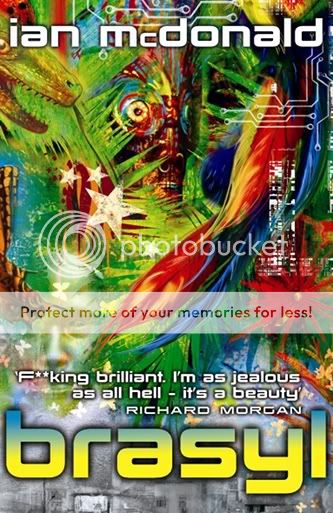
REVIEW: BRASYL

Cover Illustration: Dominic Harman/Arena
Cover Design: Sue Michniewicz

BRASYL
BY
IAN McDONALD

ISBN: 978-0-575-08288-5
Pages: 411
Publisher: Gollancz
Publishing Date: 28 August 2008

On the cover:

Sao Paulo, 2032 

A city with a neon heart. A city of countless millions. A city of breathtaking wealth and life-stealing poverty. A city watched over by angels. Constant surveillance, the tracking of your every move, the ebb and flow of your money, of your life. A city where a thief could step out of the favelas and find himself trapped in the bewildering, lethal world of illegal quantum computing.

Rio de Janeiro, 2006

A city that lives on reality TV. A city of watchers and watched. A city where an ambitious TV produces could find her next big hit and lose her life. And her soul.

Brazil, 1732

A country of Eden-like beauty. A country of gold and death. A country of madness and religion. A country where a Jesuit Father sent to find a rogue priest will find faith and reality taken to breaking point.

   This is a novel that contains three seemingly unconnected storylines. That however is not in any way a disadvantage here. We get three great stories, all showcasing the exotic country of Brazil.
   Setting the stories in different timelines may seem strange, and it does seem that the 1732 storyline can have nothing to do with the two others. This is not something that bothered me.

   McDonald quickly introduces us to the settings his characters live in, and who they are. It doesn't take many pages before you get a good insight into what makes the main characters tick.
   That both the settings and the characters are so different, works as a strength. It does to a certain degree interrupt the flow of the story, it never becomes irritating or off-putting. Actually I felt that it made the book feel fresh and interesting throughout.

   The central theme here is quantum, or more specifically quantum computers. Fortunately McDonald doesn't go into so much detail about quantum that it gets confusing. He rather uses it to back up a very interesting arc-plot.
    When the three storylines finally merges, it is both a revelation, and very satisfying. And it is done in a way that feels seamless, without being too obvious before it happens.

    I really enjoyed both the philosophical and science fiction elements of this novel. McDonald handles all three time-periods with equal deftness. And nothing is neglected in favour of the others.
   This is near-future science fiction at its best, and I would urge any science fiction fan to search out this book. And it is highly recommended for those with an interest in non-Western cultures too.
   Ian McDonald has rapidly become my favourite author for earth bound science fiction.

Ian McDonald's previous book River of Gods is reviewed here.

LINKS: Ian McDonald  Gollancz

21 January, 2011

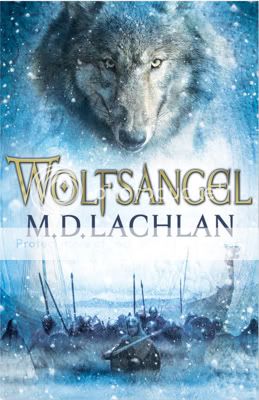
REVIEW: WOLFSANGEL

Cover Illustration: Paul Young
Cover Design: Patrick Knowles

WOLFSANGEL
BY
M. D. LACHLAN

ISBN: 978-0-575-08957-0
Pages: 438
Publisher: Gollancz
Publishing Date: 20 May 2010


On the cover: 

The creature looked at his body and it seemed to him a very fine thing. His hands were strong and large and his muscles were wound to his bones like tree roots around rock. His teeth felt like shining knives in his head.

A story of Vikings and mad gods, a story about hunger - for love, for life and for death.

The Viking King Authun leads his men on a raid against an Anglo-Saxon village. A prophecy has told him that the Saxons have stolen a child from the Gods. If Authun, in turn, takes the child and raises him as an heir, the child will lead his people to glory.
But Authun discovers not one child, but twin baby boys.

 Authun takes the children and their mother home, back to the witches who live on the troll wall. And seals all their fates.

One child will hunt a wolf, the other will become a wolf.

Both will become rivals in love. And both are tied into the schemes of a witch queen and a dead god; Odin, lord of the hanged.

    Let us start with getting one thing out of the way, I am Norwegian. And you get kind of wary of people stepping in and using your cultural heritage when you come from a small region like the Nordic, or Norse, one. To give you an example, there was some jealousy in Norway when the Disney film Hercules was announced, we have just as rich a pantheon of gods. But once the film was released, and the Greeks started complaining, people sighed in relief that we hadn't been Disneyfied. -This is what a foreigner who wants to use  Norse legends and sagas as inspiration has to tackle. (To be fair, there is still lots of Viking blood in the British Isles.)

    There's no slow start to this book. Chapter one has plenty of action, and throws you straight into the story. But although this book has plenty of action, that is not what is its real strength. What Lachlan does best is take you under the skin of the characters.
   With few central characters he has time to let us really get to know them, and as the story progresses you get pretty intimate with the lead players. There were times where I really empathized with the characters in a way that few books make me do.

    There's quite a bit of magic in the book. Thankfully Lachlan has stayed close to the shamanistic nature of Norse magic instead of using a AD&D based system. The magic here is very much a part of the story, and it is well integrated, and a Viking of the period would have no problem recognizing it.
    Lachlan also integrates the other paranormal elements seamlessly into his story. And when gods are involved you get a bit of the paranormal.

    The lack of the huge overt treat, that is the mainstay of much fantasy, does make the pace seem deceptively slow. But there is a lot going on, and there is no down-time to get you bored. The story has an inner drive that captures you, and keeps you reading.
    While Lachlan gives us much information in the first sixty or so pages, he holds back a lot for the reader to discover later. The story has many twists and turns, and at times it will have you fooled as to what is going on. It draws to a satisfying conclusion, but promises there is more to come. And if you are like me, you will want to read more of this saga

   Lets go back a bit, to where I started this review. Did Lachlan manage to stay true to the original Norse Sagas? -I think he did, in more ways than one. Not only has he gotten the feel of the sagas almost perfect, but he has stayed true to the Norse myths.
    There is no doubt that Lachlan has done his research for this novel. -To be honest, I got to say that I know he's been to Norway before writing it. He has also obviously done extensive research on the historical period, what is known as the Viking Age [Vikingtiden] here in Norway.
    Lachlan has  managed to combine the sagas with fantasy and horror, and pulled off a magnificent novel. I am eagerly awaiting the follow up Fenrir, that is released later this year.

A COUPLE OF NOTES:
-If a publisher from Norway, or any of the other Nordic countries reads this: Check out the book, I think it is well worth translating and publishing.
-M.D. Lachlan is the not so secret pseudonym of journalist and author Mark Barrowcliffe.

-This book was sent to me by the author.

LINKS: M.D. Lachlan  Gollancz

28 July, 2010

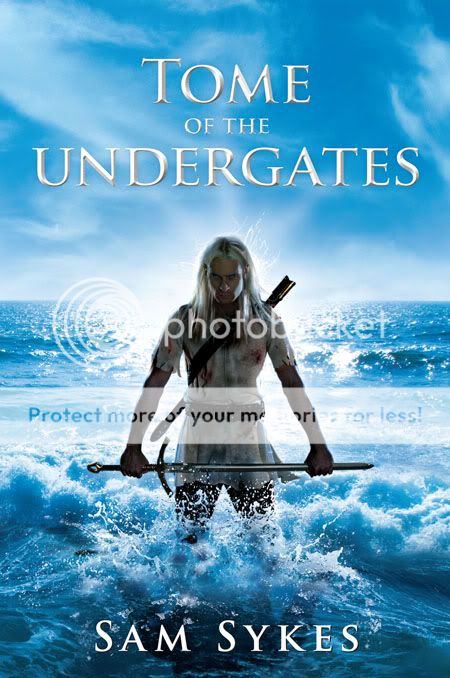
REVIEW: TOME OF THE UNDERGATES BY SAM SYKES

Cover illustration: Paul Young

TOME OF THE UNDERGATES
THE AEON'S GATE BOOK ONE
BY
SAM SYKES
ISBN: 978-0-575-09029-3
Pages: 692
Publisher: Gollancz
Publishing Date: 15 April 2010


On the Cover:
Adventurers. long loathed for their knowledge of nothing beyond murder and thievery, they are the savages, zealots, heathens, monsters; the thugs of society. And Lenk, a young man with a sword in his hand and a voice in his head, counts  them all as his sole and most hated companions.

His otherwise trivial employment under an esteemed clergyman is interrupted when bloodthirsty and eloquent pirates, led by an ageless demon risen from the depths of the ocean, pilfer the object of their protection: The Tome of the Undergates, the key to opening a door that guards the mouths of hell. A hell the demons want out of.

Against titanic horrors from the deep, psychotic warrior women, and creatures forgotten by mankind, Lenk has only two weapons: a piece of steel and five companions who are as eager to kill each other as they are to retrieve the book.
   There is a lot of Fantasy out there with focus on worldbuilding and near perfect heroes going on noble quests, so to read action-filled Sword and Sorcery feels like a breath of fresh air. And that is what Tome of the Undergates is, a good honest Sword and Sorcery adventure. Sure there is elements of  Quest Fantasy here but it doesn't take over and the book stays Sword and Sorcery for me throughout.

    There's been a lot of talk of the "200 page fight scene" that opens this book. I found this quite exaggerated, there is a lot of fighting in the first part of the book but there is also much more. Sykes is good at delivering information to the reader through the thoughts of the heroes as they are fighting. And there are several passages in between the fight scenes where you get more information about what is going on. I also felt that Sykes managed to get the personality of the adventurers across nicely.

    The action is handled very well by Sykes, and so is the interplay between the characters. What can be both a bit confusing and annoying is the fact that Sykes does not reveal much background to the reader. It takes quite a bit of time before you find out what is going on, and even then much is hidden. But as you progress in the story it becomes clear that this is done deliberately, and I felt that Sykes revelations towards the end of the book pays off the patience of waiting for answers. And I also felt that there is a lot here that is being saved for future installments, and I look forward to finding out more about these characters.

    As I stated at the beginning of this review Tome of the Undergates is Sword and Sorcery, although I must say there is a lot more Sword than Sorcery. The book reminded me a bit of Michael Moorcock's Elric, but first and foremost I was reminded of Robert E. Howard's Conan.
    So when the name Venarium pops up about halfway through the book, I immediately thought "Aha, Conan!". (Note: Venarium is the Aquilonian fort inside Cimmeria where Conan participates in his first mayor battle at the age of fifteen.) But not taking anything for granted, I used the wonder of modern social media to ask Sam Sykes if this was the case. This was his answer:
    

   "Hah, not really, no. I had no idea there even was a Venarium until Tome was finished. It's just based off Venarie, the magical source."

   And that got me thinking about a quote from Robert E. Howard of how he felt that he was relating events that had happened, and how when he couldn't write Conan later felt that the man had stopped standing at his shoulder and moved on. (The whole quote is found here, beginning at the sixth paragraph from the bottom.) -And who knows, maybe the spirit that dictated Howard in Texas has moved on to Arizona...


   Tome of the Undergates is a book for people who like the action and adventure of Sword and Sorcery. If you're a fan of Robert E. Howard's Conan, as I am, you really should get Sam Sykes' debut. And after you read it, I'm quite sure that you will join me in eagerly awaiting the next installment in the series.


LINKS: Sam Sykes  Gollancz