This is a blog with spoiler free reviews. Most will be Fantasy, Science Fiction, and Horror, but there will be some books in other genres, including the occasional Non-Fiction review. There is an ongoing series of Cover Reveal Round-Ups, and sometimes I'll write an article on something that interests me.
Showing posts with label Space Opera. Show all posts

28 March, 2014

REVIEW: OUT ON BLUE SIX

Cover design by Neil Heacox

OUT ON BLUE SIX
BY
IAN McDONALD

ISBN: 978-1-48046-165-9
Pages: 288
Publisher: Open Road Media
First published: 1 April 1989
This edition published: 31 December 2013

On the cover:
(From the publisher's website.)

In a far-future city where happiness and stability are law, a group of rebels will fight for what it means to be human

The Compassionate Society was designed as a utopia, where people’s genetic predispositions and aptitudes—rather than random choice—guide their lives, and pain of any kind is illegal. In the self-contained city, happiness is the most cherished value, and the Ministry of Pain swiftly prosecutes anyone who interferes with the contentment of another. For many of its citizens—who were matched to their jobs, spouses, and friends—the Compassionate Society is perfect. But to Courtney Hall, a political cartoonist, it is a place of stifling mediocrity. When her satirical work makes her a target of the government, Courtney goes on the run, only to discover an entire underground network of dissidents, each fighting against the stagnation imposed by the Compassionate Society—a struggle that could stand as humanity’s last chance for growth, innovation, and ultimately, survival.


   This novel is somewhat surrealist in nature, at times you feel you are going down the proverbial rabbit hole. At times it has a feel of being Fantasy, but I would say this fits nicely into the Weird. The setting, for parts of the story at least, is pure Science Fiction and there are elements that are familiar for those that are versed in Earth-set Science Fiction.

  There is two plot-strands here and although they have the similarity of both being journeys, they are very different journeys.
   On the one hand we get a quest that owes much of its structure to Epic Fantasy, more specifically Quest Fantasy. Although I hasten to add that this is not anywhere near what you'd expect from Epic Fantasy. It is much more bizarre than that, and at times it takes turns that may be hard to follow for those that are not familiar with reading SFF. However it is this greatly imaginative quality that lifts this plot thread above the average for me. The plot becomes so unpredictable because it refuses to tie itself to the expected of such a quest that you are never quite certain where it will take you.
   The other quest is more about personal discovery. It does begin with the, at this time, not uncommon narrative device of a main character who does not know who he is. But where McDonald takes it from there means it in no way feels like it is something you've seen before. Sure, there are familiar turns at some points. Parts of what is happening does seem familiar, but it is set in a narrative context that still makes this feel very fresh, even when read 25 years after the novel's first publication.

   Taken overall, the novel is a joy to read, reading my review notes made me want to read it again. There's parts of this that are absolutely brilliant Science Fiction, and likewise parts that are excellent Quest Fantasy. When put together those two elements make for a great novel.
   The page count is not very long for a SFF novel, but McDonald has managed to make this world come vividly to life with the words he has used. Other SFF novels certainly go into more detail about the world they are set in. However the feel you get for the world you are in is excellent here, and it brings you closer to how this society looks like than many novels who go on in much more detail.

   As with the setting, the characters does not really get much detail given about them. They are more defined by their actions that by who they are, but I never thought that they were too flimsy as people. Learning more about them is simply not something you miss, the narrative just doesn't need you to get to know them in that way. You do however get a good feel for who they are, and in many respects what makes them tick. They are also very nice people to follow through the narrative. Both main and supporting characters come very much alive, and you can easily relate to them on enough levels that you feel comfortable with them.

   When I was reading this, and in the time after that when I have thought about it, it's sort of hard for me to see why this book has almost disappeared. Granted, it does predate the New Weird by several years, and it does in some ways straddle the  difficult Science Fiction/Fantasy gap but it is really an excellent SFF novel. That it wasn't reprinted, and re-marketed, when New Weird became popular is a bit baffling to me.
   This is a SFF novel that deserves to be read widely. Fans of McDonald will recognise his style of storytelling, and if they haven't already read this they should remedy that at once. Other SFF fans would do well to pick this up also, and fans of China MiĆ©ville and other New Weird authors should definitely pick this up. With it's mix of Quest Fantasy and Earth-set Science Fiction it should be an excellent choice for any SFF fan.

NOTE: I got an e-ARC of this novel from the publisher/NetGalley.

REVIEWS: River of Gods  Brasyl

LINK: Open Road Media

11 March, 2014

REVIEW: THE MARTIAN


THE MARTIAN
BY
ANDY WEIR

ISBN: 978-0-8041-3902-1
Pages: 384
Publisher: Crown Publishing
Published: 11 February 2014

On the cover:
 (From the publisher's website.)
 

Six days ago, astronaut Mark Watney became one of the first people to walk on Mars.

Now, he's sure he'll be the first person to die there.

After a dust storm nearly kills him and forces his crew to evacuate while thinking him dead, Mark finds himself stranded and completely alone with no way to even signal Earth that he’s alive—and even if he could get word out, his supplies would be gone long before a rescue could arrive.

Chances are, though, he won't have time to starve to death. The damaged machinery, unforgiving environment, or plain-old "human error" are much more likely to kill him first.

But Mark isn't ready to give up yet. Drawing on his ingenuity, his engineering skills—and a relentless, dogged refusal to quit—he steadfastly confronts one seemingly insurmountable obstacle after the next. Will his resourcefulness be enough to overcome the impossible odds against him?


   Before I start off the actual review, I have to tell you a little anecdote from when I grew up. Back in around 1980 my grandparents had what would be defined as a smallholding. It wasn't big, basically just a patch of land along a road going through a farm-field.About a quarter of that property was used to grow potatoes. When I was a kid I used to help with setting the potatoes in the ground in the spring, and getting them out of there in the autumn. This was done by hand.So, despite being a city-boy I have personal experience with low-tech potato growing.

   At this point you might very well wonder what my personal anecdote has to do with a Science Fiction book? It's actually pretty essential. The growing of potatoes is essential to the whole premise of the book. And for me it is also where things start to fall apart. My recollection of potato farming doesn't completely mesh with what happens in the book. I'll grant that I could be misremembering things, it is after all 30+ years ago, but I am pretty sure there are flaws in the book's description.
   This is actually a huge problem when it comes to this novel, there is a lot that has to be bought without question when it comes to science in this narrative , most of it quite more advanced than potato growing. Usually I would have no problem accepting this science as facts, I assume that the author has done his research. But when I feel something is wrong I start on the path to distrust, and that brings me out of the story. Basically, my suspension of disbelief has ended, and I stop taking the story seriously.
   Not taking a story seriously need not be a problem. I enjoy Action Adventure and Action Thriller books, neither of which usually has a close relationship with realistic events. This is however a Science Fiction novel, and one that spends a lot of time setting up its science.

   That is really where The Martian falls down for me. It spends so much time trying to be a Hard SF book, more than enough time is spent with the science of surviving to bore anyone who isn't planning to get marooned on Mars. Even if I didn't have the potato-problem I stated above there is so much science talk here that it quickly takes on the cloak of techno-babble. Page after page of unnecessary detail that add nothing to the story, just shows off how little story there really is.
   This is coupled with lots of plot-points that make little or no sense. Even the events leading up to the novel's starting point seem to be taken straight out of an Action Adventure novel. And as in an Action Adventure novel there are problems facing the "hero" that seem totally unlikely to even occur once, yet they keep coming up time and time again. That the main character always has the skills needed to rig together a solution keeps getting less and less plausible.
   Before the novel was halfway through, I was already fed up with the obstacles put in the main characters way. There was simply too many of them, and it started to feel repetitive, like there was a list that needed to be gotten through before the end of the novel. And at times it feels like you're reading a novelisation of a Final Destination movie with all the coincidences. There were times I thought about abandoning the novel because of the repetitive series of obstacles.

   When it abandons Hard SF the novel works well. Weir writes good action and suspense, and in the passages that aren't smothered by techno-babble the novel flows well. But it is bogged down by the structure of the novel, everything on Mars is told as a journal/log. That gets very dry. Worse than that it means we are distanced to some degree from the main character, and I found I only started caring about his survival when it would mean success for the people back on Earth. I felt the main character only came to life when he interacted with others, and for much of the novel he's completely on his own.
   The Earth-set parts of the narrative work much better. There's a bigger cast of characters, and their interactions makes the story flow much better. I even found there to be more tension in what is happening elsewhere than Mars, and it also brought more immediacy to what is going on on the red planet. However, some of the tension that could have been there from the Earth point of view is lost when we already know what is happening on the surface of Mars.

   There is some glimpses of a good story here. The final chapter especially is giving us a glimpse of a suspense-filled story. Unfortunately, at that point the only thing I really cared about was being done with this book.
   If pressed to describe this book in one word I would choose uneven. It's all over the place when it comes to pacing, especially between the Hard SF parts and the Action Adventure parts. For me the Hard SF parts became just a distraction from what is in parts a good, and tense, story.They also felt completely out of place in a narrative that contains lots of elements you'd be more inclined to look for in a summer blockbuster movie than in a novel of this type.
   There's plenty of good ideas here, and at times Weir shows he can pull off a fast-paced narrative, but I feel it fails in becoming a coherent whole. There's glimpses of something much better here, but they get lost in a desire to be both action-filled entertainment and dry Hard SF. Even with all those problems I feel that this would be an interesting novel for those that are interested in fiction about the exploration of the Solar System.

LINKS: Andy Weir  Crown Publishing

21 October, 2013

REVIEW: STAR WARS: RAZOR'S EDGE


STAR WARS:
RAZOR'S EDGE
EMPIRE AND REBELLION BOOK 1
BY
MARTHA WELLS

ISBN: 978-0-345-54524-4
Pages: 288
Publisher: LucasBooks/Random House Del Rey
Published: 24 September 2013

On the cover:
(From the publisher's website)

Times are desperate for the Rebel Alliance. Harassment by the Empire and a shortage of vital supplies are hindering completion of a new secret base on the ice planet Hoth. So when Mid Rim merchants offer much-needed materials for sale, Princess Leia Organa and Han Solo lead an Alliance delegation to negotiate a deal.

But when treachery forces the rebel ship to flee into territory controlled by pirates, Leia makes a shocking discovery: the fierce marauders come from Leia’s homeworld of Alderaan, recently destroyed by the Death Star. These refugees have turned to pillaging and plundering to survive—and they are in debt to a pirate armada, which will gladly ransom the princess to the vengeful Empire . . . if they find out her true identity.

Struggling with intense feelings of guilt, loyalty, and betrayal, Leia is determined to help her wayward kinspeople, even as Imperial forces are closing in on her own crippled ship. Trapped between lethal cutthroats and brutal oppressors, Leia and Han, along with Luke, Chewbacca, and a battle-ready crew, must defy death—or embrace it—to keep the rebellion alive.


  This novel brought back a lot of memories to me. It's set two years after the Battle of Yavin (, the destruction of the first Death Star). And it has Leia, Han, Luke, Chewbacca, C-3PO, and R2-D2 in it - this is in the middle of Original Trilogy territory.
   On one hand the nostalgia is a good thing. Star Wars set in that period is the most important thing when it comes to getting me interested in Science Fiction in the first place. On the other hand it means this novel has to compete with the memory of a lot of the comics that Marvel published in the 1980s (and that I read in Norwegian translations). Honestly, I think the two cancel eachother out. The nostalgia is balanced with me having read many stories with these characters. I have already seen these characters outside the movies, so while I want to reminisce, I don't want repetition of what I've seen before.

   Wells has written a story that definitely fits in with the feel of 1980s Star Wars. It captures the action-filled Space Adventure vibe that drew me, and many of my friends, into the world of George Lucas & co perfectly.
   When this story starts out, it concern the practical realities around establishing something that will be familiar to fans of the movies. It's a nice hook, and an interesting look behind the scenes - so to speak - of the rebellion against the Empire. In itself that would be something that is interesting, although to many it could become a bit mundane. But this doesn't go that straight path, it very quickly veers off to become a much more action filled and exciting story.

   There's lots to instantly like here. Pirates, battles, betrayals, peril, action, eh...you get the picture (- don't think there's a need for me to sound like an '80s movie trailer). This is fast paced, action filled, with a lot of tension and suspense. Of course there's little suspense as to what will happen with the main characters, most of us have already seen them in two movies set after this. But Wells introduces us to some very interesting new characters that you are never certain where will end up.
   And that isn't the only tension you get in this story. Wells is excellent at getting you close to the action, and feeling the peril the characters are in. Even with the characters from the film you sometimes forget that you know where they are at a later time. Wells pulls you in with writing that makes you live in the moment of the story, and that is a great strength of this novel.

   The characters are important in this story, and of the familiar ones it's Leia Organa that shines the most here. It's good to see her at the forefront of events, and being the one who initiates much of what happens. We get to see Leia in some depth here, and she handles herself very well. Wells manages to show off Her Holiness to great effect and really make her come alive.
   There's also some very interesting new players here, one of them is very much connected to Leia. And that works very well, it means she has someone to play - and show herself off - against. It is also handled well. For me it was in some ways the deciding point of what I felt about the novel. This is something that could have broken this novel for me if it felt artificial, like something put there for the sole purpose of showing off Leia. Fortunately it doesn't. It adds a lot of depth to the story, and raises the stakes. It's the element that lifts this above the average Star Wars Extended Universe story for me.

   All in all this is a great Star Wars story for those that want to reminisce about the days between the end of Star Wars and the beginning of Return of the Jedi. And it is a great place to start for those that wants to know more about the days of the Original Trilogy. It is also a good Space Opera tale in its own right.
   Wells writes great action and adventure set in space, and you don't have to be a Star Wars fan to enjoy this novel. I can recommend this to anyone who wants a "fun romp" between the stars.

NOTE: I got an e-ARC of this book from the publisher/NetGalley.

REVIEW: Emilie & the Hollow World

STAR WARS REVIEW: Kenobi

LINKS: Martha Wells  Star Wars at Suvudu (Del Rey)

11 September, 2013

REVIEW: HYPERION

Cover based on illustration by Larry Rostant/Artist Partners

HYPERION
HYPERION BOOK 1
BY
DAN SIMMONS

ISBN: 978-0-575-09943-2
Pages: 473
Publisher: Gollancz
First published: 26 May 1989
This edition published: 12 May 2011

On the cover:

The universe of the Human Hegemony is under threat. Invasion by the warlike Ousters looms, and the mysterious schemes of the secessionist AI TechnoCore bring chaos ever closer.

On the eve of disaster, seven pilgrims set out on a quest for the legendary Time Tombs on Hyperion, home to the Shrike, part god and part killing machine with powers that transcend the limits of time and space. The pilgrims have resolved to discover nothing less than the secrets of the universe itself.


   This Science Fiction novel is, I am told, inspired by The Canterbury Tales by Geoffrey Chaucer. I'm sure that is correct, but I have very little knowledge of The Canterbury Tales myself. I've gotten the impression that they are important to English literature, but since my High School English teacher devoted three fucking months to Hamlet, we didn't have time to learn about any other part of the English literary heritage. Ahem... So, this review is done without any prior knowledge, knowing your Chaucer might make for a different reading.

   Obviously the "tales within a tale" structure is nothing new, quite a few examples come to mind within SFF, A Thousand and One Nights being the obvious one. What really matters her is how Simmons uses it. And I can't really fault what he does there.
   The six tales in Hyperion are very different from eachother, and they have influence from several genres and subgenres. They aren't only superficially influenced by these genres, but stylistically too. This makes for very diverse reading in a single novel. And it does take a bit of effort to follow the shifts when another tale comes along.

   Simmons has not only written some good stories within this novel, the novel's story itself is a very interesting one. It may not be much as a freestanding story, it would be a bit too slight for that, but it is coherent and complete.
   There is not any problem here that the revelations that matter to the overarching story is told in the tales contained within the story. It's a feature of this novel, and it works very well. Simmons gives us the information about our destination from different angles, and in completely different ways. This not only makes for great variety, it means that there is some degree of uncertainty to the information we have given. Even when everything is revealed there is a great deal of mystery left, but actually not in a way that makes this story unfulfilling.

   This being a Science Fiction novel, there's quite a bit of worldbuilding needed to give us a flavour of how society has evolved. Again, much of this is done through  the different tales. There is really a lot of great glimpses into the 28th century setting of the story.
   In the course of the novel we get some glimpses into warfare, travel, AI, family life, religion, and generally a good idea about how society has evolved. I found the world that serves as the backdrop for this interesting in its own right. The structure of this novel means that we aren't immersed to a great degree, there's simply not room for it. But what we get to see is glimpses that reveal a fascinating development from our own time.

   The characters are in many ways very integral to the stories they tell, and most of the character building is done through those tales. That the tales are so intimate means that we get pretty close to them. We do after all get to follow them through what is for some of them lifechanging events.
   They are of course a select group, not only in the obvious way that the author has chosen to tell his story through these characters, but they are also selected for this journey within the framework of the story. This can sound like a bit of "chosen one" trope, but that is far from the feeling you get when you read the story. These people may be in a special situation now, and been in special situations in the past, but they are all very much brought to life by what we learn about them.
   Structurally this novel doesn't give very much room for growth within the framework story. But that doesn't matter at all, we follow the characters and see them come to life in their own tales in a way that gets us closer to them than if we had did it through one narrative.

   This stands out among the Science Fiction I have read. The narrative gives it a very fresh feelings structurally, and Simmons' writing is excellent throughout. Like I said above, the influences from different genres work very well, and the characters are interesting to follow.
   There's nothing I can point to as being wrong with this novel, it comes extremely close to perfection, and deserves a place among the best of Science Fiction. I highly recommend this novel to anyone who has an interest in reading Science Fiction. And anyone who is a fan of the genre should see it as an obligation to pick it up if they haven't already.

LINKS: Dan Simmons  Gollancz  Gollancz Blog

04 September, 2013

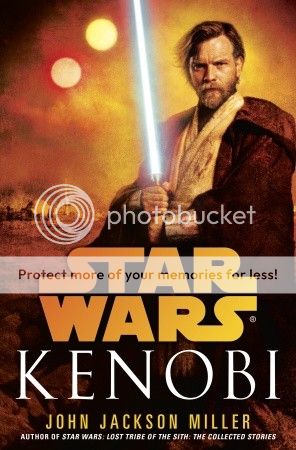
REVIEW: STAR WARS: KENOBI

Cover art by Chris McGrath
Cover design by Scott Biel

STAR WARS:
KENOBI
BY
JOHN JACKSON MILLER

ISBN: 978-0-345-54683-8
Pages: 400
Publisher: LucasBooks/Random House Del Rey
Published: 27 August 2013

On the cover:
(Taken from the publisher's website.)


The Republic has fallen.
Sith Lords rule the galaxy.
Jedi Master Obi-Wan Kenobi has lost everything . . .
Everything but hope.

Tatooine—a harsh desert world where farmers toil in the heat of two suns while trying to protect themselves and their loved ones from the marauding Tusken Raiders. A backwater planet on the edge of civilized space. And an unlikely place to find a Jedi Master in hiding, or an orphaned infant boy on whose tiny shoulders rests the future of a galaxy.

Known to locals only as “Ben,” the bearded and robed offworlder is an enigmatic stranger who keeps to himself, shares nothing of his past, and goes to great pains to remain an outsider. But as tensions escalate between the farmers and a tribe of Sand People led by a ruthless war chief, Ben finds himself drawn into the fight, endangering the very mission that brought him to Tatooine.

Ben—Jedi Master Obi-Wan Kenobi, hero of the Clone Wars, traitor to the Empire, and protector of the galaxy’s last hope—can no more turn his back on evil than he can reject his Jedi training. And when blood is unjustly spilled, innocent lives threatened, and a ruthless opponent unmasked, Ben has no choice but to call on the wisdom of the Jedi—and the formidable power of the Force—in his never-ending fight for justice. 


    This book is set more or less straight after the events of Episode III, and is from what I can see the first Star Wars book to focus on Obi-Wan Kenobi. Something that in itself should make for interesting reading to any fan of Star Wars.

   I should perhaps begin with introducing my own relationship to Star Wars. It doesn't begin at the cinema, but when the first movie aired on Norwegian TV in 1984. (This will be common in Norway.) And after that I started reading the comics, and I read all of the Marvel Star Wars comics that were published in Norwegian in 1983-1987. Except for a brief reading of some of the 1990s comics and watching the Clone Wars movie (is that EU or not?, I haven't gotten into the Extended Universe (EU) stuff. Before reading this, the only EU book I'd read was The Splinter in the Mind's Eye.
   I have however kept an eye on the Star Wars EU, and assumed that this would be quite different from what I experienced in the late 1980s. 
   I review this here on completely its own merits, I simply don't have anything to compare it to, It could be that something I react to is par for the course in the EU, but that is something I know nothing about. This is a review made by someone who has made their first dip into the EU for 25 years, and will probably be most helpful for those who have not wandered out of Star Wars' movie universe.

   The first thing I must mentioned is the main character, going by the title you'd think that would be Obi-Wan, but it isn't. Not that he doesn't feature in the book, he does. To be fair he's pretty central, but he is a supporting character. And because the presumption is that he should be the main character, that was something of a problem.
   Not that it is really fair to the real main character to complain that she is not Obi-Wan Kenobi. Annileen Calwell is a good main character. She's strong and independent, at least up to a certain point. She does suffer somewhat from having to be blind to the faults of another character so that Obi-Wan can save her... And as I write that, I realise that actually sounds pretty bad. In a way it is, but not because Annileen is a woman, but because it shows off how stereotypical many of the characters are.

   There's not much new about Annileen's situation, she's a widow with two teenage kids, making a living in a tough environment. Nothing really wrong with starting there, but it doesn't really go any further. And that is true for the other characters as well, there's no real development of characters. What you are presented with at their introduction is pretty much what you are left with when the book is over.
   The only real exception to that is one character who has a "hidden side"...I say "hidden" on purpose, because it really is obvious. Later revelations are only only revelations in the way that you get the specific level his character is on in regards to that character trait. And there's a second characters that we see develop somewhat, but being that the character is of a "race" that is extremely stereotypically portrayed, that doesn't really help. It just highlights how cardboard cut-out the rest of its members are.
   I can't really write this without actually mentioning the character who has is name on the cover. Obi-Wan does to some degree show some personality here, but it comes pretty late. Kenobi spends most of the book being a one-dimensional presence, and he's actually really annoying for the first two thirds of the novel. And I got a feeling he's kept in check because he's such an important part of the Star Wars universe. There's directions this novel could have taken that would have given Obi-Wan more layers, but they are never acted upon. It felt like a bit of a missed opportunity, and I can almost feel how the author has been hamstrung by the demands of the franchise at times.

   On to the story, it's an interesting one once you get past the stereotypical characters and situations. But that takes time.
   The first two thirds of the book are very slow. It feels like walking through the desert with all the repetitions of situations and characters. Which is really a shame, because once the story really gets going, it turns out it is a very good one. The action is well written, there are some interesting turns, and although Obi-Wan's faith is never in doubt, there is some question as to what will happen to the other characters. And some of what does happen is very well done, and has a nice twist to it.
   It is however a case of "too little, too late". Although it absolutely becomes clear that there is a good story in there, it's not one that really deserves this much attention. This would be an excellent novella if most of the first two thirds were cut. But as it stands, there's just too much waiting for the story to get going for what comes late in the book to redeem it.

   This may look like I had a very negative view of the book, but I really didn't. Despite the problems I had with large pars of it, I enjoyed the ending, the action there was great, and the twists satisfying. I think much of my disappointment stems from me having higer expectations about learning something, if not new at least interesting, about Obi-Wan Kenobi. I don't really feel the novel tried to do that, so I can't really fault it for not happening.
   There are problems here, but they are not insurmountable. And this has by no means put me off reading more EU novels, or from grabbing a book by the same author at a later date. Perhaps this is not the best introduction to the EU, but it is one that makes it interesting to take a further look at what is going on there.
   
NOTE: I got an e-ARC of this book from the publisher/NetGalley.

18 July, 2013

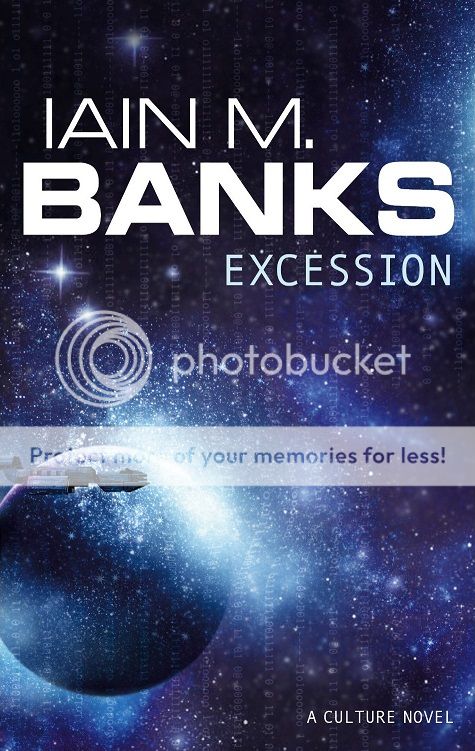
REVIEW: EXCESSION

Spaceship image by Bruce Coleman
Cover design by Blacksheep

EXCESSION
A CULTURE NOVEL/
CULTURE BOOK FIVE
BY
IAIN M. BANKS

ISBN: 978-1-85723-457-2
Pages: 451
Publisher: Orbit
First published: 13 June 1996
This edition published: 15 May 1997

On the cover:

Two and a half milennia ago, the artefact appeared in a remote corner of space, beside a trillion-year-old dying sun from a different universe. It was a perfect black-body sphere, and it did nothing. Then it disappeared.

Now it is back.


   It's really strange sitting down to write this review. When I read this book, only two months ago, the author was still with us. Granted, the news had broken that Banks had cancer and was not expected to live long, but there was talk of some faint hope. That hope is gone now, along with undoubtedly one of the best Space Opera writers that has ever lived.
   But as I read the review notes I took while I read this book, in preparation to write this words, the one thing that became clear to me is that Banks will never be completely gone. The stories he wrote will always be with us. People who are yet to be born will one day discover, and fall in love with, the Culture, and everyone and everything Banks created to bring it to life.
   Iain M. Banks is not alive anymore, but he's not gone. A part of him will always be with us in the stories he has given us.

   Excession is the fifth Culture book. And although they are not a series in the traditional SFF sense, I have noticed that there is the feeling of a progression in the series as I read it. Banks is taking us deeper into the Culture as the series progresses, and he does it through focusing on different aspects of the Culture.

   Characters have always been rather important in Banks' novels, and here some of the most important ones are the Minds, the artificial intelligences who inhabit ships, space stations, and planetoids in the Culture universe. They really come to life in this novel. The Minds have been present in previous Culture books too, but here they become much more important, in many ways they take over. 
   There are also quite a few human (and alien) characters in the novel, and Banks manages to integrate their stories very nicely with that of the Minds. The interaction, and relationship between the artificial Minds and the living creatures is done extremely well.
   The characters are very interesting, in some ways they are too interesting. There's not that many of them, but enough that it feels a bit like the reader is shortchanged with not getting to follow more of their story. Of course that is a testament to how well developed they are rather than that they feel shallow.

   There are several strands to the story at the beginning of the novel. Banks manages to create some extra suspense, for me at least, by not giving away which of the story lines that is "most important" one. It's a type of narrative structure that can be annoying to a reader, but that works very well here.
   Banks opens the book in such a way that you are very quickly hooked in to the story. As more players are introduced they become one more hook for the reader to get snagged by. And once you start to get into this story you are pretty much lost in it. But there is also quite a bit of fragmentation to the story because of its structure, and that it isn't always told linearly makes it more complex to follow than the average Space Opera adventure.

   It's the complex structure of the story that really makes it interesting in my opinion. Banks way of writing what happens in bursts rather than a straight line adds both suspense, and another layer to what is going on. Sometimes it can be a bit jolting when the narrative makes a sudden jump in time, but these jumps are not random, they always come when they can give something more to the narrative than just a distraction.
   The weaving together of the different story lines and layers is Banks' greatest accomplishment here. Although at times fractured, it becomes clear that this is very much a whole with many strands to it. It's how everything meshes together in a way that feels natural in the end that makes this such a great story.

   I've mentioned great characters and a great story. And this comes together to create something that feels like it is much more than what was really put in in the first place. To use a cliche, this is greater than the sum of its part.
   This does however lead to what I feel is the only real flaw in the novel, the ending. The build up is so good, and the story so captivating that when it ends it feels disappointing. It just feels that there should be more to it, that it should have more impact than it actually does. It's not really a huge problem, but be aware of that this really is a case of the journey being more important than the destination.

   I really like Banks' Culture stories, and despite the flaw I mentioned above this is no exception. This is Space Opera with real depth to it. More character based and philosophical than action-filled, but that is certainly a strength not a weakness.
   This is of course essential to fans of Banks' Culture books, and likewise for those who wants a cerebral background to their Space Opera. It also has a somewhat "literary" leaning to it, so it would be a nice starting point to Science Fiction for someone who comes from that reading background.

REVIEWS: You can find my reviews of the previous Culture books here.

25 March, 2013

REVIEW: KATYA'S WORLD

 Cover art by Lee Gibbons

KATYA'S WORLD
THE FIRST BOOK OF THE RUSSALKA CHRONICLES
BY
JONATHAN L. HOWARD

ISBN: 978-1-90884-412-5
Pages: 352
Publisher: Strange Chemistry
First published: 6 November 2012
This edition published: 8 November 2012

On the cover:

The distant and unloved colony world of Russalka has no land, only the raging sea. No clear skies, only the endless storm clouds. Beneath the waves, the people live in pressurised environments and take what they need from the boundless ocean. It is a hard life, but it is theirs and they fought a war against Earth to protect it. But wars leave wounds that never quite heal, and secrets that never quite lie silent.

Katya Kuriakova doesn’t care much about ancient history like that, though. She is making her first submarine voyage as crew; the first nice, simple journey of what she expects to be a nice, simple career.

There is nothing nice and simple about the deep black waters of Russalka, however; soon she will encounter pirates and war criminals, see death and tragedy at first hand, and realise that her world’s future lies on the narrowest of knife edges. For in the crushing depths lies a sleeping monster, an abomination of unknown origin, and when it wakes, it will seek out and kill every single person on the planet.

   Howard's world is an interesting one, not because it is a water planet, but because of how society works there. Much of the worldbuilding is done in the prologue, which is essentially a brief history of the planet of Russalka. I really like that approach to avoiding infodumps. It sets up the scene without slowing down the story, and it cuts down on the need for clunky conversations that exist only to impart information in the story. (I wish more writers of SFF would use this approach.)
   Science Fiction worlds that have been colonised but are not fully developed will unavoidably have at least a shade of the American "Old West" feel to them, but here that is absolutely minuscule. Society here is built not on the usual US/Western, or world government that we so often see in Science Fiction, but instead on Russia. This, along with a non-uniform range of settlements and sub-societies, makes the world Howard has created feel far fresher and more original than a quick glance will make it seem.

   This being a Young Adult novel, the heroine is of course a teenager. And Katya being a teenager is in some ways essential to the plot here, the novel would read very differently if she was an adult, and I don't think it would work as well as it does. Katya's portrayal is not in any way unrealistic, considering how she is described as growing up she acts in a way that feels very natural. She doesn't suffer from the "stupid when it serves the story, but super-intelligent when it's called for" disease that many teenage (, and adult for that matter,) characters suffer from. Instead she comes of as a well rounded person that in many ways is not very different from the people you meet in real life.
   The supporting characters in the novel are also well portrayed. They are fully formed human beings, all of them with their own agendas and histories, there's no cardboard cut-outs whose sole purpose is to fill out the scenery.

   The story doesn't waste time, already in the first chapter there's things happening that are not part of the daily routine for the characters involved, and soon after that it becomes very clear that we are in for quite an adventure.
    Once things start to happen they don't take much of a break before you reach the end of the story. There's plenty of action and a lot of suspense throughout, and Howard handles both of those elements very well. Plenty of tension is created by not really having a clue of where the story is headed, although I must admit there were a couple of minor incidents that were a bit predictable. But overall this isn't the sort of novel where all the tension comes from how things are going to happen, the story gives little away and it's not really clear where the story is headed. There's plenty of twists and turns making for a really good read.

   To sum up, this is a great Science Fiction story. It belongs to the Space Opera side of the Science Fiction genre but it doesn't have many implausible elements, making it a good read for anyone who enjoys Science Fiction -whatever their age is.
   Anyone who's come into SFF from Harry Potter and/or The Lord of the Rings shouldn't hesitate to pick this up to discover more of what the Science Fiction side of SFF has to offer.
   For me this was a thoroughly enjoyable read, and I look forward to getting my hands on future installments of Katya's story.

LINKS: Jonathan L. Howard  Strange Chemistry

23 July, 2012

REVIEW: WEIRDSPACE - THE DEVIL'S NEBULA

Cover art: Adam Tredowski

WEIRD SPACE
THE DEVIL'S NEBULA
BY
ERIC BROWN

ISBN: 978-1-78108-022-1
Pages: 259
Publisher: Abaddon Books
Published: 29 May 2012 (US/CAN)/21 June 2012 (UK)

On the cover:

Ed Carew and his small ragtag crew are smugglers and ne'er-do-wells. thumbing their noses at the Expansion, the vast human hegemony extending across thousands of worlds...until the day they are caught, and offered a choice between working for the Expansion and an ignominious death. They must trespass across the domain of humanity's neighbours, the Vetch - the inscrutable alien race with whom humanity has warred, at terrible cost of life, and only recently arrived at an uneasy peace - and into uncharted space beyond, among the strange worlds of the Devil's Nebula, looking for long lost settlers.

A new evil threatens not only the Expansion itself, but the Vetch as well; in the long run, the survival of both races may depend on their ability to lay aside their differences and co-operate.

   This is the first book in what is going to become a shared world universe. So apart from the story, the worldbuilding is of course important, and I'll start with a little bit about that.
   Considering the length of this book, you'd be forgiven for thinking that there shouldn't really be room for much worldbuilding, but there is quite a lot of it. Brown manages to get across a lot about how this universe functions in the relatively small space he has at his disposal. And he manages to do it in a way that doesn't intrude on the narrative.

   The world/universe we are presented with here is a very interesting one. It starts out as pretty much a standard Space Opera world, but it soon goes beyond that as we move into the Weird Space in the title.
   We learn quite a lot of the human Expansion, a sort of empire, but not so much that there is nothing left for later volumes. And when it comes to the aliens, we get very interesting glimpses that give us enough to go on, but leaves a lot of room for further exploration. In both cases, the humans and the aliens, what we get is intriguing enough in itself to carry this novel. And it leaves the reader with an appetite for learning more about this universe.
   The only little niggle I had with the worldbuilding was that there is a "lost race" thrown into the mix. But although that in itself is not necessarily very original, it was handled well. And I had no problem with it as the novel progressed, it is in fact one of the parts of this universe that I would like to know more of.

   So, all in all this is a great setting for a Space Opera type Science Fiction universe. It comes across as well thought out, . With lots of details that can be expanded upon, not to mention much that is hidden, this looks to be a shared world that will be well worth following in the future.

   To the story. The opening is very interesting, and I was pulled in after the first chapter. It is not long before we have had our first adventure, and from there the novel takes a turn that makes it even more interesting.
   There's actually two distinct narratives here, and the second is introduced just as the first one seems to going in a familiar Space Opera adventure direction. And although it's obvious from the start that the second narrative is connected to the first, this isn't a weakness. The extra information we get fleshes out the story a great deal, and it adds to the suspense and mystery.

   Mystery is the central word for this story. There's a lot of it, and it is very hard to get a grip of where the story is going. Brown offers up answers to the mysteries he presents, but frequently in such a fashion as to make them seem even greater. You get the feeling that there is much more to come as you read on, and you will not be disappointed. Not everything is answered fully, but there's satisfying answers that make this a fully formed novel. And there's a great sense of there being so many more stories left to tell, which is a great feat connected to the excellent worldbuilding.

   The main characters in this novel at first seem a bit standard, but as we get to know them they become very much fully developed. There's still a feel of there not being anything groundbreaking about them, but this isn't a problem at all. They are very interesting people, and it was a joy to follow their journey.
   I don't know if we will see any of them in later Weird Space volumes, but I wouldn't mind getting to know them even better. Brown is good at getting you close to his characters, and at the end it is a bit sad to be leaving them.

   As a stand alone Space Opera novel, this is a nice, fast paced, adventure story with lots going for it. There's an open ended, with the possibility of sequels, ending. But we still get a full, satisfying story.
   As the first novel in a shared world, this is excellent. We have enough info already to know that this is a very interesting setting, and there's enough that is hinted at around the edges of this novel, that there is the possibility of lots of interesting stories set in the same universe.
   If you are a fan of Space Opera, I would highly recommend getting this novel, it is a great and quick read. And I would say it would be a great introduction to the Space opera genre for those that are not familiar with it.

NOTE: The second Weird Space novel by Eric Brown, Satan's Reach, has already been announced, and has a release date of Summer 2013.

   This novel was provided to me for review by the publisher.

LINKS: Eric Brown  Abaddon Books  Abaddon Books Blog
  

25 April, 2012

REVIEW: BLUE REMEMBERED EARTH

Cover art: Dominic Harman
Cover design: Carr Design Studio

BLUE REMEMBERED EARTH
POSEIDON'S CHILDREN BOOK ONE
BY
ALASTAIR REYNOLDS

ISBN: 978-0-575-08827-6
Pages: 502
Publisher: Gollancz
Published: 19 January 2012

On the Cover:

Geoffrey and Sunday Akinya want no part of their family and its wealth. The Akinyas have ridden Africa's economic boom into orbit and beyond. Wherever mankind has gone in the Solar system the Akinyas have profited.

But Geoffrey and Sunday have rejected it all. Geoffrey conducts research into elephant cognition in the shadow of Kilimanjaro, Sunday makes her way as an artist beyond the reach of The Mechanism on the far side of the moon.

But when their grandmother dies she leaves behind a secret that throws Geoffrey and Sunday into a desperate race against their family. A race run beneath the unblinking eye of The Mechanism.

   After a rather slow and earthbound beginning, that is still very interesting, this novel really kicks into gear. Reynolds takes us on a tour of an Earth that is almost alien in its differences from the present day, and we get to see several locations in our solar system through the eyes of the main characters.
   The world of the 22nd Century presented here is very well realised, and it comes to vivid life through the story and the many glimpses we get of it in small asides throughout the novel. Reynolds manages to avoid doing his worldbuilding as infodumping, we either experience how things have changed or we get snippets of information that never feels forced into the story.

   I really enjoyed visiting the future that Reynolds has created, but it also caused the only real problem I had with the novel. This may to a great extent be caused by my own interest in History, but I didn't quite feel that the world of the 22nd century had evolved from our own. At times I had trouble seeing how our present could have turned into this future without a further explanation, and that was never forthcoming.
   However that didn't hamper my enjoyment of the exploratory journey of our solar system. I just felt that this was the little bit lacking in making this a perfect Science Fiction Adventure.

   I don't use the phrase Science Fiction Adventure without cause here. The novel is structured around a search, or a quest if you will, to find something that is hidden. A quest that takes us through most of the colonised solar system, and gives us plenty of suspense.
   Reynolds is very good at giving the reader answers while still keeping the greater mystery hidden. The answers to the big mystery comes slowly, but waiting for them is not in any way boring or annoying. Instead the structure of the novel makes for a suspense-filled journey with a rewarding destination.

   Our companions on this journey are an interesting cast of characters, especially the two main ones; Geoffrey and Sunday. They come off as fully formed human beings that come off as very realistic, Sunday to some degrees annoyingly so for me. These aren't flawless heroes that effortlessly conquer every obstacle in their way, but ordinary people who have been thrown into what is for them a difficult situation.
   The two main characters evolve quite a bit through the novel, but they don't have to carry the book on their own. They are joined by a cast of supporting characters that are sometimes more interesting in their own right than the main ones. Watching the different characters' agendas  evolve as the story progresses is a very interesting experience.

   All in all this is a great Science Fiction story. As I have already said, it is an Adventure story, and if you like the structure of Conspiracy Thrillers, you should try this on.
   As Science Fiction this belongs in the Space Opera "corner" in my opinion. The science here doesn't feel "hard", and it doesn't distract from the action and suspense. But there is neither a feel of the "magical science" that can haunt Space Opera, it feels plausible within the setting it exists in. I think all fans of Science Fiction will find this novel an enjoying read. I know I look forward to the next novel in the Poseidon's Children trilogy.


24 February, 2012

REVIEW: THE SKINNER

Cover illustration: Jon Sullivan

THE SKINNER
SPATTERJAY BOOK ONE
BY
NEAL ASHER

ISBN: 978-0-330-51252-7
Pages: 582
Publisher: Tor UK
First published: 22 March 2002
This edition published: 2 October 2009


On the cover:

WELCOME TO SPATTERJAY...WHERE SUDDEN DEATH IS THE NORMAL WAY OF LIFE

Three travellers arrive on the remote planet Spatterjay - Janer, bringing the eyes of the hornet Hive mind; Erlin, searching for the ancient sea captain who can teach her to live; and Sable Keech, on a vendetta he cannot abandon, though he himself has been dead for seven hundred years.

On its vast waterscapes only the native hoppers dare risk the voracious appetites of the planet's wildlife. Somewhere out there is Spatterjay Hoop himself - and other notorious villains who need bringing to justice for the hideous crimes committed centuries ago during the Prador Wars.

But time is running out. For one of the most brutal Prador is about to arrive, intent on exterminating all remaining witnesses to his wartime atrocities...

Major hell is about to erupt in a chaotic world - where minor hell is already a remorseless fact of everyday life...and death.

   This is one of those SFF novels that can be hard to define into a sub-genre. There's no doubt that it is Science Fiction, but much of the story is set in an environment that is much more typical of Fantasy. Ships sailing on an ocean is usually something that you find in Fantasy, or perhaps more often in Historical Fiction. Added to that there is also an element of Horror here. Not only in the titular character, but in many of the indigenous creatures of Spatterjay.
   So the question then is if this somewhat strange mix comes together and works as more than a collage? -I have to say it does, more than that - it is one of the greatest strengths of the novel.  Asher manages to use the elements from the different sub-genres to create a world that is in many ways more alien than it could have been by not being constricted by only Science Fiction "rules".
   Despite being as unfriendly as it is, Spatterjay is a very interesting world. It is well realised and by the end of the novel you'll have had a good introduction to its history and how it works in the narrative's present.

   The story is a really compelling one. It takes a while before it gets going, and there are layers added to it throughout. The pace starts out as rather slow, but like a steam-train once it gets going it builds up speed rather quickly and at times reaches a breakneck pace. 
   There are several threads that drive the story, each of them related to a different character, and each of them interesting in themselves. Asher manages to weave these threads in and out of each other with a deft hand, creating a story that comes together very satisfyingly.

   Asher has populated his world with a pretty large cast of characters. They are a varied cast, and they all feel real. Of course not all of them get the same amount of pages to give them depth, but they are still given enough time to show us who they are. 
   The main characters are an interesting group of different beings. And following their journey is an enjoyable experience. There's room for different races, species, and even artificial intelligence in the cast. They are diverse enough to not get close to boring, and they have different motivations and agendas that creates tension and excitement.

   The only problem I had with the novel was the different POVs. They change frequently, and I at times felt this made it difficult to get a feel for what was happening. It did in no way ruin the story, but it did make it a bit harder to stay immersed in it. 
   Towards the end I felt this worked much better, and I am not completely sure if it was because this mode of storytelling works better when the pace of events is greater, or if I was just getting used to it. Either way, I don't think this should discourage anyone from picking up the book unless they hate frequent POV changes.

   This was the first time I read a book by Neal Asher, and although he comes highly recommended by bloggers I trust, I didn't really know what to expect. (I tend to avoid reading too much about books I know I'm going to read.) I was not disappointed by those who recommended the book. This is a type of adventurous story that I enjoy very much. 
   I would say that this is one of the Science Fiction books I have read that would be easiest for Fantasy fans to pick up. And I would urge anyone who enjoys Fantasy, and is curious about Science Fiction to pick it up.
   All in all this is a great story set in a well realised world, with lots of action, and enough mystery and depth to make it really interesting. I'm certainly going to pick up more of Asher's books in the future.

17 February, 2012

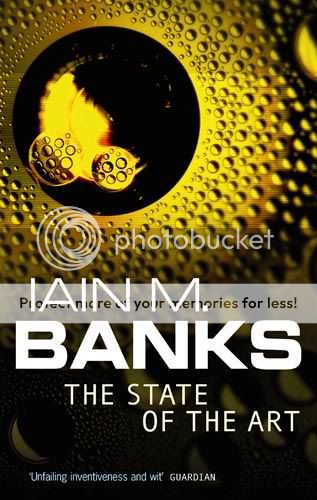
REVIEW: THE STATE OF THE ART

Cover image: Imagestate
Cover Design: Blacksheep

THE STATE OF THE ART
CULTURE BOOK FOUR
BY
IAIN M. BANKS

ISBN: 978-1-85723-030-7
Pages: 216
Publisher: Orbit
First published: 14 March 1991
This edition published: 27 May 1993

NOTE: This is a collection, but it is marked as a Culture book on Banks's website, and I'll go with what the author says .

   As usual I'll give my review of each story before saying something about the collection as a whole.

ROAD OF SKULLS

   This is a brilliant short story. It evokes a great image of the road of the title, and it may be an image that will stay with you. The story is pretty basic, but it ends in a way that wasn't expected. And that ending made me laugh. A great start to the collection.

A GIFT FROM THE CULTURE

   Wrobik Sennkil is in debt, and is given an offer he can't afford to refuse. Banks manages to put quite a lot into this tale, set in the Culture Universe. We get enough information about the main character that we understand his background, and we see his motives. There is also quite a lot of suspense involved here. This is not a bad introduction to the Culture books, should you feel the need to try out a shorter story before you go on to the novels. It works well as a short story on its own, but it is also a great story for those, like me, who enjoy Banks's Culture novels.

ODD ATTACHMENT

   This is a somewhat strange story. On the surface it's about a herder who's unhappy in love. But Banks has added another element to it that makes it so much more than that. I found it a very interesting story, and as far as Science Fiction short stories go I have to say this is among the ones I've enjoyed the most.

DESCENDANT

   A man is alone on the plains of a planet. Inside his sentient space suit he's trying to reach help. Banks manages to get across the loneliness of walking across a deserted planet beautifully. Not the most suspenseful story I have ever read, but despite guessing early on where it was going I liked it a lot thanks to Banks's great writing.

CLEANING UP

   When mysterious capsules start to spontaneously appear on earth the Americans are at the forefront of making use at what is inside them. This story is at times so surreal that it is a joy to read. Banks shows off a great sense of humor while telling an interesting story. This is great as it stands, but I would have loved to see it expanded to novel size. But that it is great enough that you don't want to leave it isn't really a shortcoming.

PIECE

   A very thoughtful story with a strong ending. A really don't want to say more about it than that you really should read it.

THE STATE OF THE ART
 
   This novella brings back Contact operative Diziet Sma from Use of Weapons. It is her retelling of what she experienced when Contact comes to Earth. Although it is revealed pretty early on in which year this happens, I'll leave it up to those that want to read this to discover for themselves when this is. It may be a surprise for those that have read other Culture books.
   We get a very detailed look at how the Culture, or more specifically Contact, approaches other civilisations here. And it adds significantly to the understanding of how the Culture operates, more so than the three Culture noels I have previously read.
   Banks also takes the opportunity here to comment quite a lot on humanity, but he avoids becoming too preachy about what he says about us. What Diziet Sma, and the rest of the Contact operatives, learn about humanity is not presented as black and white facts, but as interpretations of an alien civilisation. Something that in itself is a very interesting concept.
   This is an excellent addition to the Culture universe Banks has created, and if you have read the Culture novella and somehow missed this I urge you to do something about that at the earliest opportunity. The novella is a great standalone, but I would discourage people from from reading it before they have read at least one Culture novel. I think it is much stronger if it is an addition to the Culture rather than your first contact with it.

SCRATCH

   This is written a way that may be a bit hard to read. But if you go along with it you'll discover that there is a lot of meaning hidden in the text. A strong ending to the collection.

OVERALL IMPRESSION

   An almost flawless collection. This really showcases that Banks is truly a master of shorter than novel storytelling. The stories are varied enough that they don't feel repetitive, and the quality of them is high. Whether or not you usually read short stories and novellas, I'd urge you to pick this up if you are a SFF reader.


23 January, 2012

REVIEW: USE OF WEAPONS

Cover design: Blacksheep

USE OF WEAPONS
A CULTURE NOVEL/
CULTURE BOOK THREE
 BY
IAIN M. BANKS

ISBN: 978-1-85723-135-9
Pages: 411
Publisher: Orbit
First published: 13 September 1990
This edition published: 26 March 1992

The man known as Cheradenine Zakalwe was one of Special Circumstances' foremost agents, changing the destiny of planets to suit the Culture through intrigue, dirty tricks or military action.

The woman known as Diziet Sma had plucked him from obscurity and pushed him towards his present eminence, but despite all their dealings she did not know him as well as she thought.

The drone known as Skaffen-Amtiskaw knew both of these people. It had once saved the woman’s life by massacring her attackers in a particularly bloody manner. It believed the man to be a burnt-out case. But not even its machine intelligence could see the horrors in his past.

   This is the third in the series of Culture novels. And as the others this is technically a stand alone novel. Even though I came late to Banks' Culture and am reading them in publication order, I find it refreshing that he has chosen to not make an endless series, but instead tells different stories set in the same universe.
   There is a steady trickle of information about the Culture here, and reading them in order will give you a feeling that the world(/universe) is growing, much like you would get in a Fantasy novel when the characters travel to different areas of the map.

   This time we get the story of "super-spy" Cheradenine Zakalwe, a character it is very easy to write off a "outer space James Bond". Comparisons to Bond are almost inevitable, and I noted it myself, but I felt that this was a much more realistic portrayal of such an agent. And there certainly is much more to Zakalwe than just being a Bond clone.

   Banks actually give us two stories in this novel, the main linear plot and a side-plot consisting of the story of Zakalwe. These two narratives work very well together, instead of taking attention away from each other they serve to give more depth, and the "B-story" doesn't feel like it is thrown in to increase the page-count, as is sometime the case.
   Both plots keep building up suspense as they progress, and this keeps up the level of suspense as you are reading. And you are rewarded with a reveal that, to me at least, was pretty mind-blowing.

   All in all this is a great book. Both the characters and the story is very interesting and the Culture setting just gets better the more you read about it. I can see the reason that Banks is hailed by many as the master of Space Opera.
   This is a great book for fans of Science Fiction, and the Culture series makes a good start to written SF for those who like SF movies but have never gotten around to reading Science Fiction.

Reviews: Consider Phlebas  The Player of Games

Links: Iain M. Banks  Orbit

26 November, 2010

REVIEW: CONSIDER PHLEBAS

Cover design and photo: Blacksheep

CONSIDER PHLEBAS
A CULTURE NOVEL/
CULTURE BOOK ONE
BY
IAIN M. BANKS
ISBN: 978-1-85723-138-0
Pages: 467
Publisher: Orbit
Publishing date: 23 April 1987

On the cover:

The war raged across the galaxy. Billions had died, billions more were doomed. Moons, planets, the very stars themselves, faced destruction, cold-blooded, brutal, and worse, random. The Idirans fought for their Faith; the Culture for its moral right to exist. Principles were at stake. There could be no surrender.


Within the cosmic conflict, an individual crusade. Deep within a fabled labyrinth on a barren world, a Planet of the Dead proscribed to mortals, lay a fugitive Mind. Both the Culture and the Idirans sought it. It was the fate of Horza, the Changer, and his motley crew of unpredictable mercenaries, human and machine, actually to find it, and with it their own destruction.
 
   This is Banks' first Culture novel, but it is by no means set in an unfinished world, or more correctly; universe. There is plenty of references to other events and history here. And one of the strengths of the book is Banks' universe-building. Some of the places we see here are absolutely stunning, and adds a lot to the story.

   The story has all the ingredients of a space opera. There's a huge war going on in the background, our hero is a rogue type character who is being hunted, and we have a quest that takes us to different locations. But this story is by no means hampered by Banks' use of the familiar. He writes a story that really stands out from the crowd. The characters are also interesting, and we get to know them pretty well as the story unfolds.
  
    Consider Phlebas is pretty fast-paced. There is something happening all the time, but it is not stressful to follow what is going on. Some of the action sequences here are just mind blowing, and I have to say that I wouldn't mind seeing them up on the big screen.
   Banks is very good at keeping the suspense up, and especially the ending keeps the reader guessing. There is not much of the techno babble that scare away newcomers and slows the pace down here.

   This is the first of the Culture novels, but I would like to point out that it is a self contained story. There is no cliffhanger ending, and you should be no means be scared away from reading it just because there is a whole series of novels that follow it.
   There is much to love here for fans of science fiction. And if you are a newcomer to the genre this, in my opinion, would be a good place to start. For myself, I've already bought the next Culture novel, and plan to purchase the rest.

Links: Iain M. Banks  Orbit