This is a blog with spoiler free reviews. Most will be Fantasy, Science Fiction, and Horror, but there will be some books in other genres, including the occasional Non-Fiction review. There is an ongoing series of Cover Reveal Round-Ups, and sometimes I'll write an article on something that interests me.
Showing posts with label Novella. Show all posts

30 June, 2014

REVIEW: SAVAGE


SAVAGE
BY
GARY FRY

Pages: 66
Publisher: DarkFuse
Published: 10 June 2014

On the cover:
(From the publisher's website.)

Driving home one day from a conference, Daryl seeks a shortcut through a barren countryside. He chances upon a mysterious village whose residents seem rather odd. But they have something to show him—a creature so strange he can hardly believe it exists.

And that's only the beginning of Daryl's problems, as he seeks to escape something far worse than he can ever imagine.

Something utterly horrific and extremely savage.


   This novella begins with an established Horror trope. You know, the one where someone gets lost and finds themselves in a place that is both surreal and eerie. Interestingly enough, to me at least, this happens in Yorkshire, where I moved four months ago. Although I live a little bit from where this is happening, I am familiar with the type of location this is set in.
   Tropes aren't something that are inherently bad, although for some reason they are often talked about as if that was the case, and in this case Fry does use it to good effect. It doesn't really transcend the trope it starts out with though, although it does tweak the story such that it moves in a slightly unfamiliar direction.

   Fry does a very good job at building the atmosphere of the novella. Mostly he does so through the main character, Daryl, a character we learn a lot about in a short timespan. Daryl is an excellent protagonist for a story like this, and the author has made a very good choice in who he lets us see what unfolds through. It's unclear whether Daryl is shaped by the story, or the story shaped by Daryl, he is just a so good fit that the distinction between the two gets pointless to me. I'll leave it with the character and story perfectly complement each other.

   I already mentioned that the story makes some tweaks to the trope it uses. I found those to be both refreshing and unsettling. Unsettling in the way that it does somewhat mess with your preconceptions. The way it doesn't quite turn how you expect it to makes the story a bit unreal. It just feels like it is not quite right, it just doesn't do what you thought it would.
   Of course that feeling of unease is a plus for a Horror story, and it heightens the feeling of unease and suspense that the story conveys. but it was a little bit distracting at times for me. Not the fault of the author, but a disconnect between the story and my preconceptions about how this trope will move.
   The only slightly weak point in this story is the ending. It felt a little unsatisfying to me. It is not a bad ending, it was just that the rest of the story gave me expectations of something a little bit more than what I got.

   Overall, this is a good read. It accomplishes both creating a great atmosphere and letting us get very close to the main character in a very short time. It does also tell a nice little Rural Horror story that manages to be unsettling in both its familiarity and unfamiliarity.
   If you want a quick Horror read that makes good use of a familiar trope, I can recommend picking this up. It is a tale that is well worth spending a little time with.

NOTE: I got an e-ARC of this from the publisher/NetGalley

LINKS:  Gary Fry   DarkFuse

20 May, 2014

REVIEW: REAPING THE DARK


REAPING THE DARK
BY
GARY McMAHON

Pages: 74
Publisher: DarkFuse
Published: 20 May 2014

On the cover:
(From the publisher's website.)

A streetwise getaway driver…

A drug raid that ends in bloodshed…

A violent criminal hell-bent on revenge…

A secret order of occultists…

And something summoned from the darkest depths of nightmare.

Who will survive this long, dark night, and how will it change them? And what kind of horror will be born from the chaos left behind?

If the old adage is true and we reap what we sow, then only evil can be unleashed by Reaping the Dark.


   The prologue is your clue here. After that it seems like just another Heist Gone Wrong story for well over half the story's length. So let's deal with that part of the novella first.
   McMahon introduces us to Clarke, a getaway driver for a small gang robbing a drug deal. Things inevitably go wrong, this is how the story starts. We get an excellent Noir tale of the aftermath of the botched robbery in the opening of part one. This is Crime Noir fiction at its best. The dark underbelly of  a modern city is given us without any polishing, and the protagonist shows himself to be considerably less than an angel himself. The atmosphere is excellent, you can see a vivid picture of the grimy locations and really get a sense of unease as we learn what kind of life Clarke is leading.

   The tension is high in the first part of the novella, but when everything shifts to a Horror direction it is cranked up several notches. The tension from the Horror aspect doesn't completely overshadow that from the Crime Noir. Instead they feed off each other and amplify it to an almost unbearable level. This is simply a very tense read.
   When the story "switches tracks" it is almost disappointing that the game is given away by the prologue. But only almost. It struck me a little bit after finishing that some of the tension of the first half or so is actually created by what we learn in the prologue. McMahon has given us a little teaser, and then he makes us wau\it for a long time to see what is coming. Seen in retrospect it is excellently done, and it makes the Horror payoff all the more satisfying when it comes.

   I won't say much about the ending except that it does play on a familiar (, to me at least,) Urban Myth in a way that does not feel cheap. It does in some way make for an easy explanation, but when it comes it simply feels like it was the natural explanation.
   The very end of the story, before the epilogue, is excellent and chilling. It is not wholly unexpected, but it still packs a powerful punch.

   Overall this is an excellent novella that manages to create a near perfect blend of Crime Noir and Horror. It is not a very short story, but it comes with all the fat trimmed off. At no point do you feel like words are wasted.
   I will say that I think this is a novella that can be picked up by fans of both Horror and Crime Noir, and they will get a satisfying read. It is also a story I would not hesitate to recommend to any fan of SFF or Crime. McMahon has simply written a great novella that will give you a tension-filled and satisfying hour or two.

NOTE: I got an e-ARC of this from the publisher/NetGalley

LINKS: Gary McMahon   DarkFuse

22 April, 2014

REVIEW: DOCTOR WHO: A HANDFUL OF STARDUST


DOCTOR WHO:
A HANDFUL OF STARDUST
TIME TRIPS BOOK 5
BY
JAKE ARNOTT

ISBN: 978-1-44814-185-2
Pages: 34
Publisher: BBC Books/Ebury Publishing
Published: 3 April 2014

On the cover:
(From the publisher's website.)

The TARDIS is diverted to England in 1572, and the Sixth Doctor and Peri meet John Dee – ‘mathematician, astrologer, alchemist, magician, and the greatest mind of our time’. (‘Only of your time?’, the Doctor asks, unimpressed.) But what brought them here? When the Doctor discovers that Dee and his assistant have come across a ‘great disturbance in the cosmos, in the constellation of Cassiopeia,’ he realizes that they are all in terrible danger.


    From the cover copy above it is easy to draw the conclusion that this will be a pretty much straight forward Doctor Who adventure where the Doctor encounters  something wrong in the past that needs fixing. It is however a little bit misleading, and I don't mean that in any bad way. There is just that there is quite a bit more to it than that, and that bit gives this story a little extra. I don't want to give anyone any spoilers, but I think many will get a kick out of discovering who turns up here.

   I immediately took interest in this novella from the moment I saw John Dee's name attached to it. Dee's appearance is much more than just a gimmick, the story actually centres around the alchemist, and his assistant. Interestingly, there is a feeling that this time what the Doctor does actually has a real impact in our history. I found that a nice touch. (No, not saying any more: Spoilers!)
   However the above mentioned isn't the main part of the story, that is left for another character. And it is nice to see that character again, even if it is just briefly. This briefness is something that should be mentioned. The story is very short, and that makes it feel a bit rushed. It isn't really though, there is nothing missing from the narrative as such, and I can't say that I felt that more was needed to make the story complete. It was more of a feeling that this was over too quickly, compliment to the authors skill actually.

   Arnott is without doubt a skilled writer. He manages to create a lot of suspense and adventure in few pages here. There is plenty happening in a short space here, without, as previously mentioned, the story feeling rushed. For someone who has limited knowledge of the classic incarnations of the Doctor, (that's me - more about that at a later date,) this worked very well. The Sixth Doctor doesn't get that much description, but I still felt that I got a sense of how he is.
   There is more that could be said about this story, but I want to stick with having spoiler free reviews on the blog, so there isn't really anything left that I feel needs commenting on. 

   Overall this is a very good, and quite short story. It is a full Doctor Who adventure though, there is nothing missing from it. The things I haven't mentioned in my review, because of the "no spoilers" policy, is something I think will be very welcome to both new and old Doctor Who fans. Anyone with interest in John Dee and his doings should also find this interesting. Even with its short length I have no doubts about recommending anyone who likes Doctor Who getting this story. And those that enjoy short Science Fiction should also find this satisfying.

NOTE: I got an e-ARC of this from the publisher/NetGalley.

REVIEWS: Click here for a full list of Doctor Who reviews.

LINKS: Jake Arnott   Ebury Publishing

17 April, 2014

REVIEW: DOCTOR WHO: SALT OF THE EARTH


DOCTOR WHO:
SALT OF THE EARTH
TIME TRIPS BOOK 4
BY
TRUDI CANAVAN

ISBN: 978-144814-188-3
Pages: 39
Publisher: BBC Books/Ebury Publishing
Published: 6 March 2014

On the cover:
(From the publisher's website.)

The Third Doctor and Jo Grant arrive for a well-deserved holiday of sun and ‘blokarting’ on a salt lake in Australia in 2028. Weird sculptures adorn the landscape – statues carved from the salt. People have been leaving them in the salt lakes for years – but these look different. Grotesque, distorted figures twisted in pain. They don’t last long in the rain and the wind, but they’re just made of salt... Aren’t they?


   Canavan does not waste her time, you are given a very powerful opening. It's chilling, and it gets to you. It also introduces us to a non-human supporting character that is perhaps the best thing about this story. It's definitely a bit of a strange story, it has both a very limited cast, and a very limited setting. I am not really familiar with the Third Doctor, but have gathered that this is somewhat of a signature for this regeneration. Or at least that the limitation to an Earth setting is. 
   As an introduction to an incarnation I have only read about, this worked very well though. Canavan fleshes out what I have previously just read about, and makes it come to life. It is also interesting to see how the companion, Jo, definitely belongs to the time she originally comes from. Sure, there are updates to the technology based on what has come since then and it is set in our future, but this still feels like somewhat of a period piece. It gives off the vibe of the period when he third Doctor was on the TV screens.

   I said it was a bit of a strange story, and it is. It's actually quite hard to place this story in any conventional storytype, but it will be somewhat familiar to Doctor Who fans. This isn't one of the action filled Doctor stories, but we do get a bit of running. The lack of action doesn't hamper the story though, and it would feel wrong if some was shoehorned in.
    There is some tension as the story progresses, and a feeling of real peril. It does move fast though, everything happens within the same day. The limited time does somewhat detract from any great suspense to what is happening. When the length of the story is this short, both in pages and narrative time, it doesn't provide much space for a slow build, and I felt it could have needed more of that.
   It is not that this is a bad story in any way, but it is a bit unfulfilling. Even though it is well told it does feel a bit too pared down to the bones, and I would have liked a bit more meat on it. That said, this is a very typical Doctor Who story in the sense that it feels a little bit rushed, and that things are resolved perhaps a little bit too quickly towards the end.

   Overall this is a good story. It excels in creating a feeling of being at the setting, and time period of Jo/the Third Doctor. and for me it is an interesting look at an unfamiliar incarnation of the Doctor. As mentioned above, the end left a little bit to be desired. But that is pretty much usual when it comes to a lot of Doctor Who (, for me at least).
   If you want a short and straightforward Doctor story, this is a very good choice. And for those that miss the Third Doctor and Jo Grant this will be welcome. As a quick introduction to the Third Doctor, I found this very interesting and it makes me want to experience more of his adventures.

NOTE: I got an e-ARC of this from the publisher/NetGalley.


16 April, 2014

REVIEW: DOCTOR WHO: KEEPING UP WITH THE JONESES

Cover by Two Associates/Woodlands books

DOCTOR WHO:
KEEPING UP WITH THE JONESES
TIME TRIPS BOOK 3
BY
NICK HARKAWAY

ISBN: 978-1-44814-187-6
Pages: 49
Publisher: BBC Books/Ebury Publishing
Published: 6 February 2014

On the cover:
 (From the publisher's website.)

Deep in the gap between the stars, the TARDIS is damaged by a temporal mine. It’s not life-threatening, but the Tenth Doctor will need a while to repair the damage. But he’s not alone. The strangely familiar-looking Christina thinks the Doctor has arrived in her bed and breakfast, somewhere in Wales. In fact, the TARDIS seems to have enveloped Christina’s entire town – and something else is trapped inside with it. A violent, unnatural storm threatens them all and – unless it’s stopped – the entire universe.


   This is a story from the end of the Tenth Doctor's time. And it is unmistakenly the tenth Doctor too, you can clearly hear Tennant speak his lines in your head while you read this. Harkaway has managed to capture the personality of the tenth incarnation perfectly. The author has also found room for some signposts as to when this is happening, I'll refrain from divulging the biggest one, since I thought it was a very pleasant surprise myself. There's also a tie to a story of the Doctor's future, a nice Easter egg for those that remember that particular incident. 
   So the story is placed into the canon of the television show, but it is certainly not constrained by it in any way. This story stands very well on its own, and it is a very good one too.

   The narrative starts quite literally with a bang, as mentioned in the cover copy above the TARDIS hits a temporal mine, and from there the story takes some very interesting turns. Harkaway is good at hiding where his plot is taking us, it takes quite a long time before we get any certainty to what is happening. This certainly heightens the suspense, but it also allows the Doctor to shine. The author really shows off the curiosity and inquisitiveness the Doctor has, something that has made him such a lovable hero to so many people.
   There is a sense of fun and wonder throughout the story, even though it is quite far from a humourous story. What we do get is a story that is pervaded with a sense of tension. We know all the time that something serious is happening, and the author manages to really make the reader feel it. 

   It's not unusual for the TARDIS to be an important location in a Doctor Who story, but the way it is done here feels fresh. There's another location here that is totally new, and that has a very interesting history behind it. One that isn't immediately clear.
   Harkaway has managed to make the locations very much part of the story, as well as something that adds to the mystery and suspense. The ambiguity when it comes to where we are is very well done, and the reveal of the reality behind it was a satisfying one.

   All in all this is a very enjoyable Doctor Who story. It has some very interesting ideas behind it, and they are very well executed. For me this was an excellent addition to the Doctor's world, and I think it will be of interest to Science Fiction fans who are unfamiliar with his written adventures.
   For those Doctor Who fans that miss the Tenth Doctor this is an absolute must. If you haven't got this yet you really should point your browser at your preferred e-book retailer, you won't regret it.

NOTE: I got an e-ARC of this from the publisher/NetGalley.


15 April, 2014

REVIEW: DOCTOR WHO: INTO THE NOWHERE

Cover by Two Associates/Woodlands books

DOCTOR WHO:
INTO THE NOWHERE
TIME TRIPS BOOK 2
BY
JENNY T. COLGAN

ISBN: 978-1-44814-183-8
Pages: 49
Publisher: BBC Books/Ebury Publishing
Published: 16 January 2014

On the cover:
(From the publisher's website.)

The Eleventh Doctor and Clara land on an unknown alien planet. To the Doctor’s delight and Clara’s astonishment, it really is unknown. It’s a planet the Doctor has never seen. It’s not on any maps, it’s not referenced on any star charts or in the TARDIS data banks. It doesn’t even have a name. What could be so terrible that its existence has been erased?


   This novella opens with the interesting premise that there is actually something that neither the Doctor nor the TARDIS knows anything about. Anyone familiar with Doctor Who will be aware that this is like having a giant red button with the words "Do not press this button" below. For the Doctor it is an irresistible invitation to find out what happens. The premise was refreshing, but what was more interesting to me was how it played out. Especially how it made Clara feel at the beginning of the story.

   Clara is somewhat of a stand in for the reader here, but she has some very interesting thoughts on how the Doctor reacts to his lack of a clue as to what is going on. I won't spoil the details for anyone, but what she goes through in the story, and the conversation she has with the Doctor about it later, s to my mind something really significant. It brings another level of realism to a long established character. Not an entirely new insight, but the way it is presented, and handled, here adds some depth. The extra introspection that the written format affords does allow Colgan to delve just that little bit deeper, and it does give the story that little bit extra.

   The story itself more or less follows the standard pattern for a Doctor Who story; He, and the companion, land on a planet, something is not quite right, the Doctor runs off to find out what is going on. But things aren't quite as simple as that outline suggests here, there is an undercurrent that I mentioned in the previous paragraph.
   However, the undercurrent doesn't overpower the base story. The basic adventure story is absolutely enjoyable in its own right. It is one of the Doctor stories that leans more towards the scary side of the spectrum. There is a real sense of danger, and there is plenty of suspense throughout. You might be convinced that nothing major can happen in a novella from such a big TV-series, but Colgan's writing leads to a sense of peril that at times is so high that you will forget about that.
   There is also a very good resolution to this story, one that didn't in any way feel like it was forced. Of course the Doctor does his thing, but this time it isn't something that is pulled more or less out of thin air. It was a pleasing ending, and a very fitting one to the story that preceded it.

   Overall this is a very good Doctor Who story. It has all the ingredients that make the Doctor such a good character to follow on an adventure, and they are used to great effect by Colgan. This is a tightly written story that has everything a story needs. The beginning makes perfect sense, if you are familiar with the Doctor (- and if you are not you will understand him by the end of the story), it then builds nicely up towards a satisfying ending. This is not just a good Doctor Who story, but a good novella in itself.
   For fans of Doctor Who, and especially the eleventh Doctor and Clara, this is an absolute must. For those that want a quick Science Fiction novella this should also be a satisfying little adventure. And even though it is early days in the series yet, it looks like Time Trips will be an excellent first trip into written Doctor Who for those that haven't ventured there before.


20 November, 2013

REVIEW: THEN WILL THE GREAT OCEAN WASH DEEP ABOVE

Cover by Kay Sales

THEN WILL THE GREAT OCEAN WASH DEEP ABOVE
APOLLO QUARTET 3
BY
IAN SALES

ISBN: 978-0-9571883-6-5
Pages: 71
Publisher: Whippleshield Books
Published: 30 November 2013

On the cover:

 It is April 1962. The Korean War has escalated and the US is struggling to keep the Russians and Chinese north of the 38th parallel. All the men are away fighting, but that doesn’t mean the Space Race is lost. NASA decides to look elsewhere for its astronauts: the thirteen women pilots who passed the same tests as the original male candidates. These are the Mercury 13: Jerrie Cobb, Janey Hart, Myrtle Cagle, Jerri Sloan, Jan Dietrich, Marion Dietrich, Bernice Steadman, Wally Funk, Sarah Gorelick, Gene Nora Stumbough, Jean Hixson, Rhea Hurrle and Irene Leverton. One of these women will be the first American in space. Another will be the first American to spacewalk. Perhaps one will even be the first human being to walk on the Moon.

Beneath the surface of the Atlantic Ocean, deep in the Puerto Rico Trench north of San Juan, lies a film bucket from a KH-4 Corona spy satellite. It should have been caught in mid-air by a C-130 from the 6549th Test Group. That didn’t happen. So the US Navy bathyscaphe Trieste II must descend twenty thousand feet to retrieve the bucket, down where light has never reached and the pressure is four tons per square inch. But there is more in the depths than anyone had expected, much more.

This is not our world. But it very nearly was.


    Having previously enjoyed the first two Apollo Quartet books (reviews here and here), I was really looking forward to see what Sales would do this time. That's one of the strengths of the Apollo Quartet; the books are themed around the US space program that led to the Moon landing, but Sales does something different with it each time. This time we get pure Alternate History, the timeline doesn't even reach 1970. But Sales sticks to the science so judiciously that this in many ways reads like Hard SF, or more precisely like Hard SF of the 1950s could have been.

   There's two very distinct story threads this time around. The main one concerns female astronauts. And before I even go into this book, I have to commend Sales for digging up some history on this part of the story. Some of that is shown in a short section at the end of the book, but it really is something I want to look into further.
   The story of the female astronauts is also a very gripping one. There's a lot of tension in some of the things that are going on. This is solid storytelling, and it will come out favourably compared to any Science Fiction concerned with human near-Earth space travel. It may feel a bit old-fashioned because of the time it is set in, but that doesn't detract from it as a very compelling story in my opinion.
   With the solid factual base behind it, and Sales' excellent extrapolations from it, this reads very much like a history of human space exploration. Sales also gives us a plausible explanation for why events have turned the way they have in this timeline, and you can see how easily this could have been our world.

   In the other story Sales goes off at the deep end, literally. We're taken on a very deep sea dive outside of Puerto Rico. There's the same kind of tense excitement here as in the other story thread, we are after all in another environment that is hostile to human life.
   We get a slightly different type of story here though, this has a bit more of the Spy Thriller in it, and there's even an element here that comes straight from the fringes of UFOlogy. That is not to say that this lacks in realism in any way. In fact there's not really anything that says this isn't what really happened. At least until the very end.

   Both of the stories are more introspective than action oriented. We follow the inner thoughts of the two protagonists and these are important to the novella. I never missed any action, or more outright Science Fiction elements though.They are simply not needed here, and would just get in the way of what Sales wants to tell us.

   The characters become important in stories such as these, and how you feel about them can be integral to your enjoyment of what you are reading. The two we meet here are nice to get acquainted with. Although this is a novella we do get fairly close to them, and can see what makes them tick in the situations we see them. That the level of characterisation is so good makes this feel like it spans over a much greater number of pages. Sales manages to convey a lot in the few pages he has allowed himself.

   All in all this is a very good novella. The story is compelling in itself but the history behind it, that is given an alternate twist, gives it more depth and punch. This is a story that has importance outside of genre, and deserves to be read widely far outside the confines of SFF.
   This is absolutely brilliant Alternate History, it covers angles that is (as far as I know) ignored within that genre, and stands as a great testament to how serious and close to reality you can get within this genre.
   Sales is again showing that he can write very engaging fiction about space exploration while sticking to the rules of Hard SF. This is fascinating and engaging storytelling with enough depth to satisfy the most discerning reader.

NOTE: I got an e-ARC of this from the author.

REVIEWS: Adrift on the Sea of Rains  The Eye with Which the Universe Beholds Itself

LINKS: Ian Sales  Whippleshield Books

18 September, 2013

REVIEW: THE EYE WITH WHICH THE UNIVERSE BEHOLDS ITSELF

Cover by Kay Sales

THE EYE WITH WHICH
THE UNIVERSE BEHOLDS ITSELF
APOLLO QUARTET 2
BY
IAN SALES

ISBN: 978-0-957-18833-4
Pages: 77 (Including glossary/appendix)
Publisher: Whippleshield Books
Published: 17 January 2013

On the cover:
(From the publisher's website)

For fifteen years, Earth has had a scientific station on an exoplanet orbiting Gliese 876. It is humanity’s only presence outside the Solar System. But a new and powerful telescope at L5 can detect no evidence of Phaeton Base, even though it should be able to. So the US has sent Brigadier Colonel Bradley Elliott, USAF, to investigate. Twenty years before, Elliott was the first, and to date only, man to land on the Martian surface. What he discovered there gave the US the stars, but it might also be responsible for the disappearance of Phaeton Base… 


   Like Sales previous Apollo Quartet novella, Adrift on the Sea of Rains (review), I'd define this as Hard SF Alternate History. It's not a direct follow up to the previous novella, in fact it's not even set in the same timeline. That sounds strange for two books that have a title collecting them together, but it really isn't. The operative word in the quartet's title is Apollo. That is what keeps these stories together. Not the god by that name, but NASA's Apollo Program.

   This time the main character is Bradley Emerson Elliot, who we follow at two major turning points of his life. Both have to do with space exploration, and both have significance for much more than Elliot himself.
   The Apollo space program, specifically the alternate history expansion of it, is very well handled by Sales. It's used as a really strong foundation for the story, and keeps it grounded in our reality even when it diverges from it. There's absolutely no doubt that the author has done his research. I especially liked how theories from the "fringe/alternative" corners were integrated.
   Sales has managed to stay on the right side of the Hard SF worldbulding/infodumping divide. There's more show than tell, and even when he does tell he manages to do so in an interesting manner.

   Being a novella, there's not much space for intricate character building (, not that I think there should be). But Sales has found room for giving us some insight into the character traits of Elliot that effects the story. Within the confines of this little slice of his life, Elliot is fully formed. And we also get some insight into his personal life that gives us a deeper understanding of him.
   There's isn't really room for getting to know the other characters that pop up in the course of the story, but that doesn't matter one bit. At least it was not something that I felt was missing. This is in one way the personal story of one man, and the focus on him makes the story more intimate.
   This is really an intimate story, but at the same time it's a very big one. The main character is present at some very important events, and thus this becomes his personal story. Bu for humanity as a whole, this story has much greater implications. And the story excels at that blending that together. Elliot isn't dumped into events, he as a natural place in them.

   There's a lot of tension in the story, even when we know that what the story makes us fear is not going to happen. Sales is very good at building up that atmosphere of uncertainty, there's a real feeling that anything can happen. Which is a testament to good writing when the storyline is split into two parts that are twenty years apart.
   More important than the mysteries though, is the journey. Both Elliot's personal/physical journey, and the bigger one that humanity does because of what Elliot experiences. The former is connected to space exploration and the latter follows from that. And although there are certainly strong Science Fiction elements in both, they feel like they are a natural extension.
   I must make a small addendum to my mention of the journey here. When you reach the end of the novella itself, it doesn't feel very fulfilling. It's like there is something missing, and there is. The following Glossary and Coda are a part of the story. They fill in the little bit that was missing, and adds quite a lot more of the history around what precedes it. I'd like to add that the story we get through the appendices to some extent exceeds what is contained within the relatively few pages of the book.

   Overall this is a great Hard SF novella. It is also a great Alternate History novella. Sales has created an excellent alternate world, that reads like Near Future Hard Science Fiction of the 1960s without in any way feeling old-fashioned. There's enough story here to comfortably fill a much larger volume, but it still doesn't feel crammed together. 
   This is an excellent starting point for those that want to take a look at Hard SF or Alternate History. For anyone who enjoys those genres this is an absolute must.

NOTE: I got an e-ARC of this from the author.


12 July, 2013

REVIEW: THE COLORADO KID

Cover art by Glenn Chadbourne

THE COLORADO KID
BY
STEPHEN KING

ISBN: 978-1-848631-26-7
Pages: 174 (+afterword)
Publisher: PS Publishing
First published: 4 October 2005
This edition published: December 2010

On the cover:
(From the publisher's web-site. There's no text on the actual cover.)

On an island off the coast of Maine, a man is found dead. There's no identification on the body. Only the dogged work of a pair of local newspapermen and a graduate student in forensics turns up any clues, and it's more than a year before the man is identified. And that's just the beginning of the mystery. Because the more they learn about the man and the baffling circumstances of his death, the less they understand. Was it an impossible crime? Or something stranger still? 

   I feel it's important to get one thing clear from the outset when it comes to this novella; It is not SFF. If anyone ever needed any evidence that King is not solely a SFF writer, this would be exhibit A. What we have here is a story belonging in the Mystery genre. A strange mystery perhaps, but not as strange as to take it into the SFF genre.

   We learn very early on that this is a mystery, and what this novella really is, is the story of this mystery being told to (what is arguably) the book's main character. And what really struck me is how simple, yet complicated, the structure of this story is.
   In one way the story is actually too simple to really work. Although I thought it was great the whole time when reading it, there was the feeling every time I did my review notes (,something I do after every chapter, ) that this shouldn't really work. But it is undeniable that it does. Part of it comes down to King's storytelling ability, something that this kind of storytelling structure really shows off to great effect. And part of it is because although you do know it is a mystery, the discovery of what the mystery is makes for compelling story in itself.

   We get quite close to the main characters, there's three of them. And in a sense these three characters are more important than the mystery we are being told about. It's the interaction between the three, the two who tell the story of the mystery and the one being told the story, that makes everything work - even though as I pointed out earlier, in some ways it shouldn't.
   King manages to tell us quite a lot about these three characters as the mystery is told. I really felt I got close to them, and by the end of the novella I had even come to care about them. That is not really unusual for King's characters, but he does show here that he can do it in few pages if he is so inclined.

   This really is a story that appeals to my love for the weird and strange. In many ways it is common - just a slice of reality - but at the same time it is a wonderfully bizarre story that fits in very well with some of King's more fantastical work.
   I think this would be of interest to anyone who likes mystery, and also to those that like to read about a slice of small town life. And it should be a high priority for those that like to see the mundane mixed with the strange.
   And of course, it goes without saying that this should have a place on the shelves of every Stephen King fan. This is King at his absolute best, and he really shows off how great a teller of stories he is in this novella.

NOTE: I don't do "buy links" (, a matter of principle for me,). But I know this can be a bit difficult to find in a paper edition, so if you want to own this novella in Hardcover version it might not be a bad idea to start looking on the publisher's website.

LINKS: Stephen King  PS Publishing

27 August, 2012

REVIEW: ADRIFT ON THE SEA OF RAINS

Cover by Ian Sales

ADRIFT ON THE SEA OF RAINS
APOLLO QUARTET 1
BY
IAN SALES

ISBN: 978-0-9751883-1-0
Pages: 75 (Including Glossary/Appendix)
Publisher: Whippleshield Books
Publsihed: 6 April 2012

   On the cover:

When a nuclear war breaks out and the nations of earth are destroyed, it maroons a group of astronauts on the Moon. Using the "torsion field generator", they hope to find an alternate Earth that did not suffer nuclear armageddon. But once they do, how will they return home? They have one Lunar Module, which can carry only four astronauts into Lunar orbit...

   Sales's novella is very Hard SF one, but as it becomes clear rather quickly it is set in an Alternate History. This may seem like being a contradiction, but Sales manages to make it work very well.
   Interestingly it is neither the Hard SF nor the Alternate History elements that are the best thing in this story. What stands out most is the feeling of desolation and claustrophobia that Sales conveys through his writing. There is an underlying tension to the whole of this, that together with the chilling Alternate History scenario in the background makes for a very eerie read.

   Being a fan of Alternate History, I care about how "what if..." scenarios are presented. It doesn't matter how interesting an idea the diversion from our history is if there's no plausible way to get to the alternative world that the story contains. Fortunately, that is not a problem here. Sales presents a future that seems to be  just a flicker of coincidence away from the history we know.

   There is something that has to be mentioned about the Hard SF in this novella, namely that it very easy to argue that there is none. This may sound a bit strange of me to say when I have already stated that this is "very Hard SF", but the SF is only Hard SF in the Alternate History setting of the story.
   If you, like some people I have seen online, argue that Alternate History is Fantasy, rather than Science Fiction, then this would be a Fantasy novella. As someone who has a strong interest in History, I would say that Alternate History is without a doubt Science Fiction (, i.e. scientific speculation about how history could have diverged), and thus I don't hesitate to say that this is a Hard SF story in an Alternate History setting.
   Without going into spoilers, I will say that there is an element that isn't very realistic. But in the way it is handled here that is not a problem. Rather it feels as an integral part of the alternative timeline of the story, and in my opinion doesn't detract anything from the Hard SF feel of this novella.

   The story itself is very well written. Sales manages to convey a lot in a limited amount of space,  especially the worldbuilding is excellent. Most of the history of this timeline is presented in its own passages, as retrospectives. I found this to work very well, they add to the main storyline without being disruptive to the flow of the story.
   I've already mentioned the tension of this story, and that builds nicely as the narrative moves along. It's never clear what is going to be the conclusion to this tale, and the ending comes with a very satisfying twist.

   There's no doubt that this story will be a great read for those who are fans of Hard SF, and the Alternate History elements make it worth picking up for fans of that genre. It's connection to the Apollo program will also make this a good read for anyone interested in real world human space exploration.

Note: I won a Hardcover edition of this in a competition on the author's website, and I have received an e-ARC for review.

LINKS: Ian Sales  Whippleshield Books

17 February, 2012

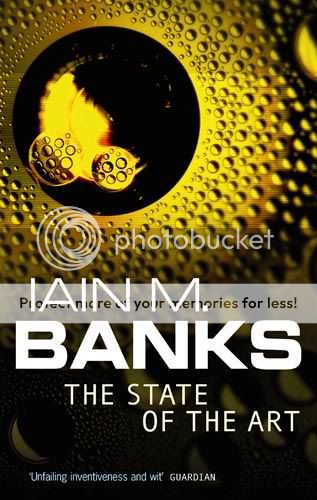
REVIEW: THE STATE OF THE ART

Cover image: Imagestate
Cover Design: Blacksheep

THE STATE OF THE ART
CULTURE BOOK FOUR
BY
IAIN M. BANKS

ISBN: 978-1-85723-030-7
Pages: 216
Publisher: Orbit
First published: 14 March 1991
This edition published: 27 May 1993

NOTE: This is a collection, but it is marked as a Culture book on Banks's website, and I'll go with what the author says .

   As usual I'll give my review of each story before saying something about the collection as a whole.

ROAD OF SKULLS

   This is a brilliant short story. It evokes a great image of the road of the title, and it may be an image that will stay with you. The story is pretty basic, but it ends in a way that wasn't expected. And that ending made me laugh. A great start to the collection.

A GIFT FROM THE CULTURE

   Wrobik Sennkil is in debt, and is given an offer he can't afford to refuse. Banks manages to put quite a lot into this tale, set in the Culture Universe. We get enough information about the main character that we understand his background, and we see his motives. There is also quite a lot of suspense involved here. This is not a bad introduction to the Culture books, should you feel the need to try out a shorter story before you go on to the novels. It works well as a short story on its own, but it is also a great story for those, like me, who enjoy Banks's Culture novels.

ODD ATTACHMENT

   This is a somewhat strange story. On the surface it's about a herder who's unhappy in love. But Banks has added another element to it that makes it so much more than that. I found it a very interesting story, and as far as Science Fiction short stories go I have to say this is among the ones I've enjoyed the most.

DESCENDANT

   A man is alone on the plains of a planet. Inside his sentient space suit he's trying to reach help. Banks manages to get across the loneliness of walking across a deserted planet beautifully. Not the most suspenseful story I have ever read, but despite guessing early on where it was going I liked it a lot thanks to Banks's great writing.

CLEANING UP

   When mysterious capsules start to spontaneously appear on earth the Americans are at the forefront of making use at what is inside them. This story is at times so surreal that it is a joy to read. Banks shows off a great sense of humor while telling an interesting story. This is great as it stands, but I would have loved to see it expanded to novel size. But that it is great enough that you don't want to leave it isn't really a shortcoming.

PIECE

   A very thoughtful story with a strong ending. A really don't want to say more about it than that you really should read it.

THE STATE OF THE ART
 
   This novella brings back Contact operative Diziet Sma from Use of Weapons. It is her retelling of what she experienced when Contact comes to Earth. Although it is revealed pretty early on in which year this happens, I'll leave it up to those that want to read this to discover for themselves when this is. It may be a surprise for those that have read other Culture books.
   We get a very detailed look at how the Culture, or more specifically Contact, approaches other civilisations here. And it adds significantly to the understanding of how the Culture operates, more so than the three Culture noels I have previously read.
   Banks also takes the opportunity here to comment quite a lot on humanity, but he avoids becoming too preachy about what he says about us. What Diziet Sma, and the rest of the Contact operatives, learn about humanity is not presented as black and white facts, but as interpretations of an alien civilisation. Something that in itself is a very interesting concept.
   This is an excellent addition to the Culture universe Banks has created, and if you have read the Culture novella and somehow missed this I urge you to do something about that at the earliest opportunity. The novella is a great standalone, but I would discourage people from from reading it before they have read at least one Culture novel. I think it is much stronger if it is an addition to the Culture rather than your first contact with it.

SCRATCH

   This is written a way that may be a bit hard to read. But if you go along with it you'll discover that there is a lot of meaning hidden in the text. A strong ending to the collection.

OVERALL IMPRESSION

   An almost flawless collection. This really showcases that Banks is truly a master of shorter than novel storytelling. The stories are varied enough that they don't feel repetitive, and the quality of them is high. Whether or not you usually read short stories and novellas, I'd urge you to pick this up if you are a SFF reader.