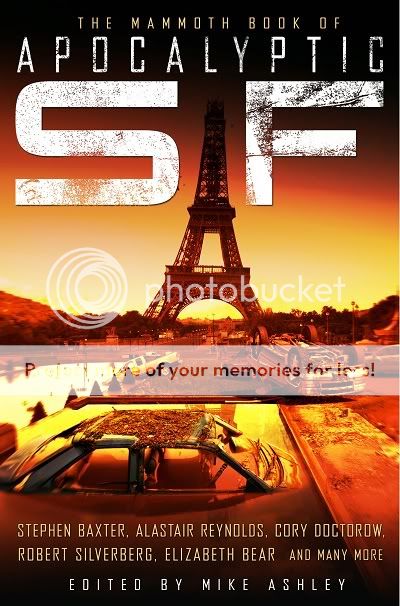
Cover design and art: Joe Roberts
THE MAMMOTH BOOK OF APOCALYPTIC SF
EDITED BY
MIKE ASHLEY
ISBN: 978-1-84901-305-5
Pages: 500
Publisher: Robinson
Published: 27 May 2010
On the cover:
APOCALYPSE NOW?Have the last days begun?
Humankind has long been fascinated by the precarious vulnerability of civilization and of the Earth itself. When our fragile civilizations finally go, will it be as a result of nuclear war, or some cosmic catastrophe? The impact of global warming, or a terrorist atrocity? Genetic engineering, or some modern plague more virulent even than HIV or Ebola?
As usual when I review anthologies, I will give a (very) brief review of each story before I give an overall view of the anthology.
WHEN WE WENT TO SEE THE END OF THE WORLD by ROBERT SILVERBERG
First published in Universe 2 edited by Terry Carr (Ace Books, 1972)
This is a story about commercial time travel to the end of the world. It's a pretty strong apocalyptic story. It is pervaded by a strong sense of irony that Silverberg manages to convey rather nicely. And it's a really good start to the anthology.
THE END OF THE WORLD by SUSHMA JOSHI
First published at http://www.eastoftheweb.com , 2002
A Nepali set story about end of the world prophecy. Joshi manages to tell a lot in just a few pages. The story is well written, and it is very refreshing to see an Apocalyptic Science Fiction story set outside the Western world.
THE CLOCKWORK ATOM BOMB by DOMINIC GREEN
First published in Interzone 198, May/June 2005
Set in war-torn Africa, this is a cautionary tale. Although this is very much Science Fiction, both in that it is set in the future and that it has a main element that is classic Science Fiction, the topic is very relevant to our time. This makes it a better story, and it is one I really liked. It is made all the better by avoiding being preachy.
BLOODLETTING by KATE WILHELM
First published in Omni, June 1994
This story centres around the wife of a scientist/viruologist. At its core this is actually a relationship story (, I wouldn't go so far as calling it romance), it's the story in the background that makes it Science Fiction. And the Science Fiction part is both original and very well written. It's a different take on a familiar story, and I highly recommend reading it.
WHEN SYSADMINS RULED THE WORLD by CORY DOCTOROW
First published in Jim Baen's World, August 2006
A very tech-centered story about trying to keep the world together when it faces the apocalypse. This is actually a pretty good story, but it fell a bit to far from my tastes. For me it was way to tech-oriented. Apart from the tech aspect the rest of the setting barely felt sketched out. I have no doubt it will appeal strongly to to those who are more interested in the workings of tech than I am, but I felt the scope of the story is too narrow to make it universally appealing.
THE RAIN AT THE END OF THE WORLD by DALE BAILEY
First published in Fantasy & Science Fiction, July 1999
Endless rain all over the world is the apocalyptic setting of this story about a woman who tries to escape the catastrophe with her husband. In some ways I would hesitate to cal this Apocalyptic Science Fiction. Although that is the story's setting its theme is a much more mundane one. It is not a bad story, but I feel its theme has been done so many times that it didn't give me something new.
THE FLOOD by LINDA NAGATA
First published in More Amazing Stories edited by Kim Mohan (Tor, 1998)
On an island threatened by rising waters one man tries to stand against the pressures of his wife to follow the lead of others. A rather strange story. The writing is good, but it didn't really connect with me, I'm sure others will find it to their liking.
THE END OF THE WORLD SHOW by DAVID BARNETT
First published in Postscripts 9, Winter 2006
A look at events leading up to the end of the world, done with a humorous twist. This is a pretty weird story, it is both serious and very lighthearted. It's a very original take on the genre, and I found it very refreshing. Definitely a story worth reading.
FERMI AND FROST by FREDERIK POHL
First published in Isaac Asimov's Science Fiction Magazine, January 1985
This is a typical Cold-War nuclear apocalypse tale. And as such it feels dated now, and I can't see that it would have felt very fresh or original when it first was published back in 1985. This story failed to speak to me at all. It is technically well written, but that is all it has going for it. Neither the story nor the characters stand out from the many other nuclear war stories.
SLEEPOVER by ALASTAIR REYNOLDS
First publication
Reynolds tells a tale of a very dystopic future. It's a strange story with a central premise that can be a bit hard to wrap your head around at first, but it does grow on you. I really liked this story, mostly because it felt original to me in many ways. There are certainly elements that are familiar from other Science Fiction tales, but here they are taken in a different direction. A great story from a future with an unexpected apocalyptic event.
THE LAST SUNSET by GEOFFREY A. LANDIS
First published in Asimov's Science Fiction Magazine, February 1996
A very short end of the world story that still manages to pack in quite a lot. It is a kind very short story that I really like. And Landis has managed to let the main character come more to life in under four pages than some authors do in a whole novel. I highly recommend this.
MOMENTS OF INERTIA by WILLIAM BARTON
First published in Asimov's Science Fiction Magazine, April/May 2004
This is a strange Post-Apocalyptic story. It takes a bit of time to get a grip on the structure of it, but once you do it has got a very good flow to it. This will not be for everyone, it is a bit too surreal for that. It's a good story that is a bit let down by confusing jumps back and forth in the timeline.
THE BOOKS by KAGE BAKER
First publication
This is the story of three children who discover a treasure house in a deserted post-apocalyptic city. This is really a great story, and one I think every reader will find to be a great experience to read.
PALLBEARER by ROBERT REED
First publication
A story about who survived the apocalypse, but just as much about what caused it. All told through the eyes of a single person, and what he has experienced. This made me a bit uncomfortable. There are lots of questionable messages here that aren't really explored in a way I feel they should have been. Whether getting the reader thinking about it was Reed's intention I don't know, but that is not the way it came across to me. This is one story that you have to make up your own opinion about, I'm not really sure what to think.
AND THE DEEP BLUE SEA by ELIZABETH BEAR
First published in Sci Fiction, May 2005
Bear tells the story of a woman driving through the wasteland to deliver a package. A good story that is slightly let down by it feeling like it has been told many times before.
THE MEEK by DAMIEN BRODERICK
First published in Synergy SF edited by George Zebrowski (Five Star, 2004)
This story feels like a pointless exercise in stringing paragraphs that seem to have been edited out of a literary Science Fiction novel together. If it has anything to tell at all, it seems to consist of the opening Bible quotation and the last sentence. Utter drivel.
THE MAN WHO WALKED HOME by JAMES TIPTREE JR.
First published in Amazing Science Fiction Stories, May 1972
This is a story of two journeys through history. It is excellently written and really grabs hold of the reader. It is definitely one of the best stories in this anthology, and it is an example of a really great Science Fiction short story.
A PAIL OF AIR by FRITZ LEIBER
First published in Galaxy Science Fiction, December 1951
Leiber serves up a tale of a very different post-apocalyptic world. This is a truly original offering, at least I have never read anything like it before. It is a beautifully written story with great characters, tension, and it takes the reader on a wonderful journey.
GUARDIANS OF THE PHOENIX by ERIC BROWN
First publication
A story of travelling across a warm deserted landscape. There's a lot to this story besides the basic quest format it takes. Brown has managed to give the reader a good idea of how the world looks, and how it functions. The story is also a nice take on hope in a desperate situation. Very enjoyable.
LIFE IN THE ANTHROPOCENE by PAUL DI FILIPPO
First publication
This story is set in a very well realised post-apocalyptic future. The story itself is not as important as the worldbuilding here, although it is a very good story. The future presented here is a very interesting one, it is a setting I would like to see much more of. Great Science Fiction.
TERRAFORMING TERRA by JACK WILLIAMSON
First published in Science Fiction Age, November 1998
Williamson has written a story that is about exactly what the title says. It's a wonderful story full of human drama. I loved this story when I read it in Science Fiction Age on its first publication, and I don't think any less of it now - quite the opposite. In my opinion this is the best story in the anthology, and one that every Science Fiction fan should read.
WORLD WITHOUT END by F. GWYNPLAINE MACINTYRE
First publication
This is the diary of the last human. It is a great concept, and it is very well executed. This is a story I really liked, it is a quick personal tale that has a lot of heart to it.
THE CHILDREN OF TIME by STEPHEN BAXTER
First published in Asimov's Sience Fiction Magazine, July 2005
Baxter gives us several snapshots of the history of the world after the apocalypse. The way the story is structured works very well despite its short length. It's a "fun" look at what might be humanity's future that makes for a great short story.
THE STAR CALLED WORMWOOD by ELIZABETH COUNIHAN
First published in Asimov's Science Fiction Magazine, December 2004
The story of an old man living in the wilderness. This is in many ways a "quiet" story, one that doesn't need to shout to tell its tale. It is a lovely little melancholy story, and it serves as a great ending to the anthology.
OVERALL IMPRESSION
As with any anthology not all the stories here were for me, but there was more hits than misses and only one real dud. I read this on and off for a couple of months, and I think that is the best way to read it. Although there are many differences between the individual stories, this anthology felt a bit too restrictive in subject matter, and that made the stories feel to similar.
I would have liked this to have a broader scope in subject matter, but that isn't the real problem. I felt that this was way too centered on the US, remove a couple of stories and you could call it The Mammoth Book Of American Science Fiction Apocalypses. I would really have liked to see more stories set elsewhere, even Europe is neglected here.
Despite the problem I had with the narrow subject and location, I enjoyed this anthology. The stories themselves are different enough that it doesn't get boring, and there's enough spread in original publication dates to make it an interesting peek at this Science Fiction subgenre.
It is a great place to start for those who want to check out Apocalyptic Science Fiction. And if you are a fan of that genre already and doesn't have this book, you really should remedy that at the earliest possibility.