This is a blog with spoiler free reviews. Most will be Fantasy, Science Fiction, and Horror, but there will be some books in other genres, including the occasional Non-Fiction review. There is an ongoing series of Cover Reveal Round-Ups, and sometimes I'll write an article on something that interests me.

23 March, 2011

REVIEW: SPELLWRIGHT

Cover Illustration: Keevil Design
Cover Design: HarperCollinsPublishers

SPELLWRIGHT
BY
BLAKE CHARLTON

ISBN: 978-0-00-733276-2
Pages: 350
Publisher: Harper Voyager
Publishing Date: 27 May 2010

On the cover:

Nicodemus Weal has trained at the stronghold of Starhaven since he was a boy. His mentor, the famous wizard Magister Shannon, taught him how to cast spells made from luminescent magical runes, how to peel written words off a page and make them physically real. Initially, Nicodemus showed great promise. Able to forge runes with great speed, he was once thought to be the Halcyon - a powerful spellwright prophesied to prevent the apocalypse known as the disjunction.

There was only one problem: Nicodemus couldn't spell. Every time he touched a magical text, he unintentionally corrupted it, creating a dangerous, potentially deadly misspell. Now aged twenty-five, while his peers advance as wizards, he is still an apprentice, dealing with the devastating knowledge that he has failed to live up to prophecy.

But not everyone interprets prophecy in the same way. There are factions who believe someone like Nicodemus could hold great power - power that might be used as easily for evil as for good. And when two of the wizards closest to Nicodemus are found dead, it becomes clear that some of those factions will stop at nothing to find the apprentice and bend him to their will...

   Charlton is quick to get the reader into the story. And he is also quick to introduce a central mystery that is  
both interesting and intriguing. The mystery part of the story is presented to us in the first couple of chapters, and while this seems pretty ordinary at first the setting makes it something else entirely.
   While the story at times can seem predictable, there are several layers of complexity added as it progresses, and it takes several turns that I didn't expect. It is not an especially long novel, for fantasy, but it contains a lot of action and suspense. One of Charlton's strengths is that he does not overwrite, but lets the story flow without unnecessarily slowing it down.

   I love fantasy that has history, a world that has seemingly organically grown, and Charlton presents us with that. It is not done in info dumps, but is trickled out at natural points as the story progresses. By the end of the novel you'll have an idea of the world Nicodemus inhabits that makes it interesting to see what comes next. 
   Even in the somewhat constricted world of Starhaven we get glimpses into the politics and conflicts of the wider world. Something Charlton does very well. The rivalries between different groups is handled with skill, and adds a lot to the story.

   What separates this most from other works of fantasy is the magic system. Charlton has created a language based magic system that at first seems pretty straight forward and simple, but as we learn more it comes apparent that it is very complex. 
   The magic is also in many ways integrated seamlessly into the story. And not used as a way of getting the characters out of impossible situations as we often see in fantasy. It is great to see magic in fantasy presented in a way that feels fresh and original.

   In conclusion, I can say that this is a thoroughly enjoyable and suspense-filled debut from Charlton. It is not a book that is overly taxing to read, and it has a legacy rooted more in the traditional epic fantasy than the "gritty" or "new weird" that seem to be the vogue these days.
   I'd recommend this to any fan of fantasy, but especially to those that enjoy a good and complex magic system.

21 March, 2011

IMPORTANT INFORMATION: GENRE FOR JAPAN


   Genre For Japan is an initiative that I wholly support. And I urge everyone else to do the same. Here is the press release with the info you need. Read it, and go take a look at the site:

Press Release: Time to Donate Prizes!

We’ve all heard the news and seen the horrific pictures coming from Japan in the aftermath of the Tōhoku earthquake and tsunami – and no doubt we’ve all wondered how to help.

Following the example of Authors for Japan, where bids are now closed, we’d like to introduce Genre for Japan, a chance for the comics, science fiction, fantasy and horror communities to unite and show our generosity to those who need it right now.

We are planning to run auctions for genre-themed prizes and we need YOU to donate. We are looking for really fantastic prizes: examples might include signed first editions, coaching sessions with agents for that perfect submission letter or original artwork!

Some of the prizes already donated include a year's supply of books from Tor, signed artwork from Solaris Books and editing/critiques from professional authors and editors.
The prizes will be auctioned on our website, through JustGiving, in aid of the British Red Cross Tsunami Appeal.

If you have something really special to donate, please drop us a line at genreforjapan@gmail.com including information such as a starting bid amount, a sentence or two about the item, and whether you wish to send the prize to a central collecting point or would be willing to post it to the winning bidder. Photos would also help us to list the item, if relevant.

The deadline to receive offers of prizes is 25th March, with the auction set to begin on 28th March.

Find out more information on our website: http://genreforjapan.wordpress.com/
Follow us on twitter: @genreforjapan
E-mail us: genreforjapan@gmail.com

Genre for Japan is organised by:
Amanda Rutter: reviewer and webmistress at Floor to Ceiling Books
Jenni Hill: editor for science fiction, fantasy and horror publishers Solaris Books
Louise Morgan: author and interviewer for the British Fantasy Society
Ro Smith: writer and reviewer; blogger at In Search of the Happiness Max
Alasdair Stuart is the editor of Hub magazine.

18 March, 2011

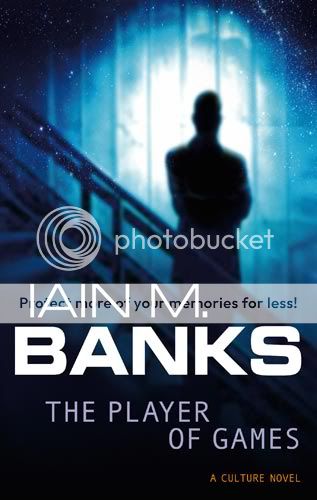
REVIEW: THE PLAYER OF GAMES

Cover Image: Getty Images
Cover Design: Blacksheep

THE PLAYER OF GAMES
A CULTURE NOVEL/
CULTURE BOOK TWO
BY
IAIN M. BANKS

ISBN: 978-1-85723-146-5 
Pages: 309
Publisher: Orbit
Publishing Date: 1988

On the cover:

The Culture - a human/machine symbiotic society - has thrown up many great Game Players, and one of the greatest is Gurgeh. Jernau Morat Gurgeh. The Player of Games. Master of every board, computer and strategy.


Bored with success, Gurgeh travels to the Empire of Azad, cruel and incredibly wealthy, to try their fabulous game ... a game so complex, so like life itself, that the winner becomes emperor. Mocked, blackmailed, almost murdered, Gurgeh accepts the game, and with it the challenge of his life - and very possibly his death.

   The central premise of this novel is games, or to be more specific, a game that is complex enough to run an empire. Not the most common of science fiction principles, but a very interesting one.
    Banks is very adept at getting his concept across to the reader. First by introducing us to the game-player Gurgeh and his life. Through Gurgeh we get a very good idea of how the Culture treats games, and what position they have in society. The introduction of a world run by a game is done in such a way that you never get the feeling that Banks is talking about something hypothetical, but instead it feels both plausible and real.

   The story itself is great, it has the plausibility that in my opinion is needed to get immersed in SFF, and it doesn't lack in suspense. Banks manages to keep the info dumping integrated to the story, and it doesn't slow down the narrative.
   It is a rather short book, and is a quick read. That doesn't mean that it lacks complexity. There are many parallels to our world here, and if you feel like it this is a novel that is a great springboard for analysis. Even the descriptions of the Culture's differences to the Empire of Azad serves to highlight that we are in a wholly different world from what we know. But at the same time it is not lacking in references to real-world society.

   There is much to learn about the Culture here. And as this is the second novel Banks has written about the Culture, that is a good thing. He is expanding on his creation too great effect. And the shadow of the much larger world that exists outside the novel is very much present.
  
   This book is not an action-filled space adventure, but an immersion into a different culture in a future setting. It is a type of social science fiction I thoroughly enjoyed. If you are at all interested in science fiction for more than big guns and spaceships I advise you to read this book, it is one I know I will re-read sometime in the future.

Note: This novel is marked correctly by the publisher as "A Culture Novel". It is not a direct continuation of the events in Consider Phlebas, the novel that preceded it. But it is set in the same universe, and although the two novels are very different, they are part of a series.

Review: Consider Phlebas

Links: Iain M. Banks  Orbit

16 March, 2011

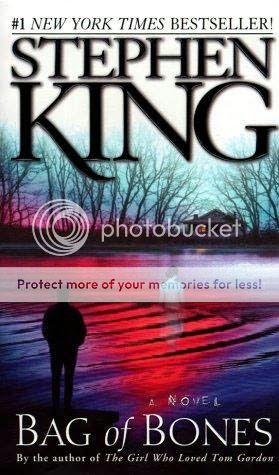
REVIEW: BAG OF BONES

Cover Illustration: Tom Hallman
Cover Concept: Lisa Litwack

BAG OF BONES
BY
STEPHEN KING

ISBN: 978-0-671-02423-9
Pages: 732
Publisher: Pocket Books 
Publishing Date: 22 September 1998

On the cover:

Four years after the sudden death of his wife, forty-year-old bestselling novelist Mike Noonan is still grieving. Unable to write, and plagued by vivid nightmares set at the western Maine summerhouse he calls Sara Laughs, Mike reluctantly returns to the lakeside getaway. There, he finds his beloved Yankee town held in the grip of a powerful millionaire, Max Devore, whose vindictive purpose is to take his three-year-old granddaughter, Kyra, away from her widowed young mother, Mattie. As Mike is drawn into Mattie and Kyra's struggle, as he falls in love with both of them, he is also drawn into the mystery of Sara Laughs, now the site of ghostly visitations and escalating terrors. What are the forces that have been unleashed here - and what do they want of Mike Noonan?

   This is one of those Stephen King books that you usually won't hear about. And let's face it, most people, even those who like the horror genre, seem to have trouble coming up with titles for King's books that hasn't been filmed.
   I almost never seek out reviews of books by authors I like before buying them. And with this book I started reading it without knowing anything about it. In fact I didn't even read the flap copy (,the "On the cover:" above,) before starting it.

   King doesn't waste time pulling you into this story. By the end of page one, we know that the wife of main character Mike Noonan has died, and by the end of page two we have been told there is something mysterious connected to her death. By this time I was hooked.

   This is one of King's novels where a writer tells us his story, and this time it is done in first person. The choice of first person works very well, King uses it to really get us to know Noonan, and it certainly adds to the suspense that we get inside his head.
   King uses the first seventy or so pages to get us to know Noonan before ratchetting up the tension. For me this worked excellently, when things started to happen I was already invested in Noonan's story. And the set-up part doesn't feel boring or unnecessary.

   The central theme here is a ghost story, and it is this that gives the novel its horror aspects. But there is also much more than that. There is human drama in abundance, all excellently done by King. We get the almost obligatory small-town setting that King is the master of, and a cast of very interesting characters.
   I have trouble thinking of anything that weakens this story, and it is in my opinion worthy of a high placing on the list of good King novels. Whether you like Stephen King, ghost stories or suspenseful human drama this is a book I can heartily recommend.
   If you are a King fan, and have yet to read this, you really should make it a priority in my opinion.

I'll leave you with a great quote from the book (, found on page 102 in the edition I have read for this review):

I like people who read actual books, and not just because I once wrote them myself. Bookreaders are just as willing as anyone else to start out with the weather, but as a general rule they can actually go on from there.

Reviews: The Shining
               Four Past Midnight

Links: Stephen King  Simon & Schuster (Pocket Books)

28 February, 2011

REVIEW: VEGAS KNIGHTS

Cover: Spring London

VEGAS KNIGHTS
BY
MATT FORBECK

ISBN: 978-0-85776-086-2
Pages: 368
Publisher: Angry Robot Books
Publishing date:  3 March 2011*

On the cover:

It’s a kind of magic...
 
When two college students decide to spend Spring Break using their magic to fleece the casinos of Las Vegas, little do they imagine that the city harbours some magical secrets of its own... And of course what happens in Vegas, stays in Vegas – alive or dead.

   As you perhaps can see from the cover image, this book has been called "Ocean's Eleven meets Harry Potter". I don't disagree much with that assessment, and it is certainly a good description of the basics of the story for anyone not well versed in the genre.
   But I would rather describe it as Neil Gaiman's Books of Magic meets Las Vegas meets [good] Hollywood Action-Thriller.

    At first this seems to be a pretty standard story of two friends going to break the bank in Vegas, with the only added ingredient being the use of real magic. But it doesn't take long before you realize this novel is much more than that.

    Forbeck quickly pulls you into the story, I was hooked by the end of the first chapter.  It doesn't take long before you realize there is quite a complex back story here, and it is one that is revealed over the course of the novel. Something that works very well. You always feel that there is more to be revealed, and that makes this a book that is hard to put down once you have started it.
    It is a fast-paced story, there is lots of action and that is why I used Hollywood action-thriller as a description at the beginning of this review. But it doesn't feel like the action is placed there just to "up the ante", it is an integral part of the whole.

   Another strength of this novel is that Forbeck is very good at adding that little magical twist to our world that signifies good Urban Fantasy. Everything is slightly different from the reality we know, but never so much that it becomes too implausible. A couple of the revelations were of the kind that made perfect sense, and I actually wouldn't be too surprised if it really was the way Forbeck tells it in this book.

   The characters in this book are interesting, especially the main character. And even those that same pretty typical have something fresh about them.  I enjoyed following Jackson and Bill's journey through this version of Vegas, and I wouldn't mind following them to other places in the future.

   Overall this is a fresh and suspenseful Urban Fantasy novel.  It is great entertainment, and if you have a taste for fantasy in a contemporary setting this is definitely worth checking out.
   This will also make a great read for anyone interested in stage-magic, Las Vegas, and casino card games.

NOTE: An ARC of this book was supplied to me by the publisher.

*Release date 3 March 2011 is for UK and electronic editions. (Although it should be up on the UK Kindle store now.) Release in USA and Canada is 29 March 2011.

LINKS: Matt Forbeck  Angry Robot Books

27 February, 2011

REVIEW: GARDENS OF THE MOON

Cover Illustration: Steve Stone

GARDENS OF THE MOON
THE FIRST TALE OF THE MALAZAN BOOK OF THE FALLEN
BY
STEVEN ERIKSON

   ISBN: 978-0-593-06506-8
 Pages: 516
Publisher: Bantam Press
Publishing date: 1 April 1999

On the cover:

Bled dry by decades of warfare, infighting and bloody clashes with Anomader Rake, Lord of Moon's Spawn, and the mysterious Tiste Andii, the Malazan Empire simmers with discontent. Even the Imperial legions, long inured to the bloodshed, yearns for some respite. Yet the Empress Laseen's rule - enforced by her feared assassins, the Claw - remains absolute.

For Sergeant Whiskeyjack and his squad of Bridgeburners, and for Tattersail, surviving sorceress of the Second Legion, the aftermath of the Siege of Pale should have been a time to help the still-living to mourn the many dead. but the Empress has other ideas. Darujhistan, last of the Free Cities of Genabackis, still holds out against her and it is towards this ancient and noble bastion of independence that she turns her predatory gaze.

However the Empire is not alone in this great game. Other sinister, shadow-bound players are poised to make their first moves - as Captain Ganoes Paran, aide to the Empress' Adjunct, is about to discover. For he has been chosen for an altogether higher purpose - as a harbinger of the gods themselves...

   The first thing that I really noticed about this novel, was how much is going on. There are multiple locations, a huge cast of characters, and several points of view. I didn't have a problem with all the characters or the many point of views, I've read quite a bit of Harry Turtledove and is used to that from there.
   But I have to say I was very glad that I have a habit of taking notes when I read books for review. It really came in handy here, and I would actually advise anyone who is going to read it for the first time to write down a sentence or two from time to time to keep track of everything.

   This is fantasy on a truly epic scale. I had been warned about this, and Erikson mentions it in his foreword, but at 516 pages it didn't look daunting at all. That is purely an illusion.
   Erikson doesn't really waste anytime at all. By the end of chapter two (page 69) it is clear that there is a vast amount going on. There is plenty of action throughout, but Erikson also finds room for massive amounts of information about the world.
   The worldbuilding here is very well done. You get a constant trickle of information about both the present day, and the history of the world. There is so much information that you feel that this is a world that has grown over thousands of years, something I really appreciated as I'm a bit of a history geek. 
   Fortunately there aren't really any info-dumps as such here. I never felt that what was told of the background to what is happening was forced into the story. It has the feel of being given naturally by the characters when they tell it. And I found that to be a great strength in this book.

   As for the story, I really enjoyed it. It is rather complex, there is just so much happening that it is easy to loose track if you don't give it your full attention. I like books that are like that, so I enjoyed immersing myself in Erikson's world. 
   It is a very rich story, with characters that you feel you get close too. And the fact that the characters themselves have to discover what is going on, makes it feel like you are taking the journey with them instead of just following them.
   There are very few times in this story when there is not something happening somewhere. And in these few quiet periods Erikson gives out bits of information that drives the story along. It never feels like there are any times where you are reading padding material.
   The suspense level is kept pretty high at all times, and it can actually feel a bit daunting at times that every answer gives you at least one new question. But it really pays off.

   What more can I say? I really loved this book. And as I write this I'm about 100 pages into Deadhouse Gates even though I had planned to write this review before starting to read it; I just couldn't wait.
   This is excellent epic fantasy, and I don't hesitate to recommend it to anyone who likes secondary world fantasy. Be advised though; this is not a light read. It demands you invest in it, but it gives so much back in return that it is very much worth it.

Review: Solaris Book of New Fantasy -Contains a non-Malazan short story by Erikson.


26 February, 2011

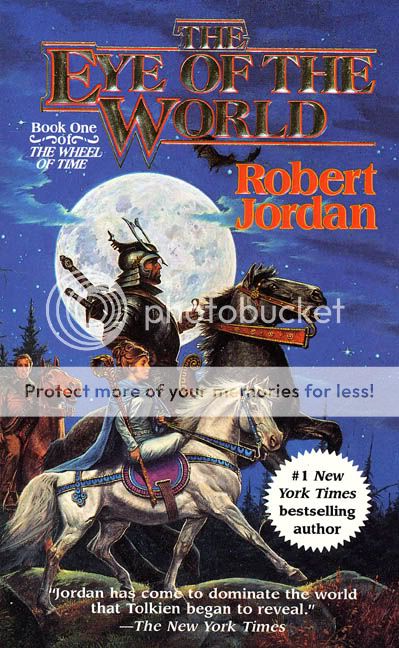
REVIEW: THE EYE OF THE WORLD

Cover Art: Darrell K. Sweet

THE EYE OF THE WORLD
THE WHEEL OF TIME BOOK 1
BY
ROBERT JORDAN

   ISBN: 978-0-8125-1181-9
Pages: 782
Publisher: Tor
Publishing date: 15 January 1990

On the cover:

The Wheel of Time turns, and Ages come and go. What was, what will be, what is, may yet fall under the Shadow. Let the Dragon ride again on the winds of time.

   NOTE: As you can read here this is the first time I've read this book. And I have not been following the series at all, so I basically know nothing about what comes later. So this review is written in the same way it would be if it was the only Wheel of Time book in existence.

   Let's begin with the obvious, Jordan steals/borrows heavily from J.R.R. Tolkien's The Lord of the Rings. Not just the formula, but characters, locations, monsters and events are more or less carbon-copies from TLoTR.
   I don't mind the occasional nod to other works, but here it is not so much nods as a barrage of headbutts. It was in fact so much of it, that I found it really annoying. Especially since this has been done before by Terry Brooks in The Sword of Shannara (1977) and Margaret Weiss & Tracy Hickman in The Dragonlance Chronicles (1984/1985). There's also one character that has some striking similarities to a character from Stephen Donaldson's The Chronicles of Thomas Covenant (First and Second Chronicles 1977-1983, sorry I don't remember which book).
   So the level of originality in this book is pretty low. So if you expect that, this is certainly not the book for you. -But let's move on.

   The worldbuilding seems a bit lacking. There's several things that just don't seem to add up in the kingdom that most of Eye of the World is set in. What I reacted to most, was the political side of things.
   There's a sect that opposes the queen. Yet they have much more power in the capital, where there are plenty of "Queen's guards", and next to no power in the outlaying districts of the kingdom where the queen has no presence that we hear about. Add to that the fact that these outlaying districts is far closer to the power-base of the sect, it made little sense to me. And it totally lacks any explanation in the story.
   It seems that there is not much real worldbuilding at all, and that the world is just thrown together to fit with what is needed for the plot. Making it inconsistent, and neither believable nor logical to me.

   There's nothing wrong with the story itself, although it is a "light" fantasy done after a formula. Jordan has embraced the tendency of epic fantasy to go into descriptive mode. Unfortunately he does this way too much, and inconsistently. There were lots of detailed descriptions of what I found to be uninteresting things. But when it came to some of the cities, where a description could have added to the understanding of culture and thereby the worldbuilding, he chooses to give only a fleeting description. Something that was disappointing to me.

   The pacing of the book was rather slow. The endless description dragged it down, and there is really not a lot happening. There were several times when the book picked up the pace, but these ended quickly, and it was back to the plodding along.
   Overall the book gave you the feeling of being stuck in traffic. Every time it started moving forward a bit, and I got hopeful that things were going forward, it clogged up again and ground to a halt.

   There are several other things that I think is wrong with this book that I could mention, but there is no real reason for me to go on.
   I wouldn't really recommend this book if you want to read epic fantasy, there are lots of books out there that are much better. But if you loved The Lord of the Rings, and miss fantasy that evokes memories of it, this would be a perfect book for you.

See also Malazan Book of the Fallen vs The Wheel of Time

LINKS: Dragonmount (Wheel of Time community)  Tor Books

08 February, 2011

AMAZON'S HIDDEN EXTRA CHARGES: DOES AUTHORS AND PUBLISHERS GET A CUT?

INTRODUCTION

  On January 28th this year I got a newsletter e-mail from HarperCollins Book Blast, informing me that a free Septimus Heap book was available, in formats including Kindle.
   I'm not a huge fan of e-books, but this is a book I've seen in Norwegian translation in the bookstores here. So I wanted to take a look. I downloaded Kindle for PC, and clicked on the e-mail link. What happened next surprised me:
   Amazon.com wanted to charge me $2 for the book whose buy page listed the book's title as "Septimus Heap, book one: Magyk Free With Bonus Material".
   This got me curious, so I started to investigate.

AMAZON.COM'S HIDDEN INTERNATIONAL CHARGES

   After encountering what I related above, I started checking out Amazon.com. (NOTE: In Norway you get directed to Amazon.com for Kindle purchases.) It turns out that Amazon charges an extra $2 for many of its Kindle books, but not all. However searching for Kindle books, with lowest price first, shows up no books under $2. But I have found other books as low as $0.99, this could be a glitch based on other findings I have made.

   When I first looked at this on January 28th, most books on Amazon's official list changed price. This has been rectified, and they now show up with a $2 higher price. A reason I stated above that the books who doesn't get the $2 price raise could be a glitch. 
   I asked a US blogger I know to check the price of A Game of Thrones on the Kindle some hours ago, the answer was $5.00. Here's the image I got on my buy page here in Norway:
   And it even says that it "includes free international delivery". (Amazon Whispernet looks to be another name for the internet as far as looking at Amazon tells me.) 

    I tried to get an answer to this on Amazon's forums. I could find no answer to it from anyone officially affiliated with Amazon. Several international Kindle users reported price hikes in the $0.99-$3.20 range, even on free Kindle books. And the same users had bought the Kindle with free delivery stated. Someone even on the day before their forum post.

    American forum users blamed this on European governments. Answering this, several posts from Europeans stated that VAT was a percentage, not a flat fee, and that however many percent of 0 = 0. (Some of the posts pointing out it could not be VAT were flagged as "Does not add to the discussion"...)
    I checked Norwegian VAT laws. They were a bit difficult to sort through as I don't speak legalese, but there is no VAT for imports under 200 NOK (Norwegian Kroner) to Norway. (At 06.10 February 8, this is $34.65.)
    And I would think that Amazon would tell me if I was paying any charges they have no control over.

PRICING EXAMPLES

    I wanted some concrete examples from today, so I found a user list on Amazon that had different prices than the buy page. Prices on the list have been updated, I assume automatically, since it was written. Many books are priced above the "Free to $2.99" the list is said to cover. However, as opposed to the above example with A Game of Thrones, this list has not been updated with the automatic $2 hidden charge.

    I asked author John Locke, on twitter, if I could use his books as a pricing example. He said yes, and here is what the list above shows:
    This is what the buy page shows:
    This is the $2 hidden price raise for buying in Norway I have been talking about.
 
DOES AUTHORS AND PUBLISHERS GET A CUT?

    So to the question in this blog post's headline: Does authors and publishers get a cut?

    This to me is the interesting question. Where do the extra $2 go? It doesn't actually matter to me personally. I'm only going to download free e-books to my Kindle for PC. But since there is absolutely no mention of it on Amazon, that I managed to find, I started to wonder. I could have asked John Locke, but I wanted to write this blog post based on what an average customer could be expected to find out.

    It is very interesting if Amazon alone pockets the extra $2. For John Locke it means that international Kindle sales, of at least some of his books, should have given him three times as much money.
    For a publisher we could potentially be talking huge sums if they are not aware of this. And if they are not, Amazon could be in some trouble.

    There is of course a chance that both authors and publishers are aware of this, and get their cut of the extra money. Something I don't have a big issue with. But it means that free books for Kindle is not something an international customer can see as an argument for buying the Kindle. (NOTE: Gutenberg.org does have Kindle editions of their free books. But most of these are out of copyright books.) 
    It seems at best very immoral to me that international customers have to pay an extra charge that is, judging from Amazon's own forums, not defined. And not in any way made public knowledge.

    I would love for authors and publishers to comment on whether they were aware of the hidden $2 charge. And also to give their reactions to it. 
    I would of course also welcome comments from international Kindle customers about their experience with this, and what they think of it. And I would like to hear from American, and other Kindle customers with regional Amazon shops too.

NOTE: I have other examples. But felt it was enough with those I have used. 

02 February, 2011

REVIEW: KRAKEN

Cover Photo: Elisa Lazo Valdez/Arcangel Images

KRAKEN
BY
CHINA MIÉVILLE

ISBN: 978-0-333-98951-7
Pages: 481
Publisher: Macmillan
Publishing Date: 7 May 2010

On the cover:

Deep in the research wing of the Natural History Museum is a prize specimen, something that comes along much less often than once in a lifetime: a perfect, and perfectly preserved, giant squid. But what does it mean when the creature suddenly and impossibly disappears?

For curator Billy Harrow it's the start of a headlong pitch into a London of warring cults, surreal magic, apostates and assassins. It might just be that the creature he's been preserving is more than a biological rarity: there are those who are sure it's a god.

A god that someone is hoping will end the world.

   This is urban fantasy. Or to be specific, what urban fantasy was during the nineties, before it somehow got usurped to define something that even its fans have problems differentiating from paranormal romance.

   Miéville does cities very well, and he does the London of this story excellently. The world building is great, this London seems alive and breathing, and it is well realized enough that it doesn't take much suspension of disbelief to see that it could be this way.
   There are a lot of religious cults in this book, and some readers may find that these are a bit of a stretch. But you don't actually have to plow too deep into the myriad of religions that exist today to find out that they are entirely plausible. Some of them are even pretty close to what is out there in our world.
   The organizations that Miéville populates his London with are also well within the reasonable. I especially liked the FSRC, and have no problem seeing that such a unit could exist even in our world.

   The book begins with events that seem normal enough, but the strangeness start before the first chapter is finished. And from there on its a journey into a weird and slightly askew London that is well worth a visit.

   We also quickly get to know most of the principal characters, and they are for the most part excellent company throughout the story.
   There was one exception from this for me , Marge. She seems to be far to normal to take things in her stride the way she does. And this grated on me for parts of the book.
   I also found Billy Harrow a bit to diffuse at times, he seems to both deny what is happening, and be fine with everything at different parts of the story. And I felt the switch in his character to more active towards the end of the story was more of a plot necessity than natural progression of him as a character.
   These are however minor points, the setting and characters serve the story well. And Miéville does both of these parts of the novel expertly.

   So to what I found as a strength in The City & The City (review here), the prose, and Miéville's use of it.
   It just does not work here. Technically it is excellent, as always with Miéville, but it does not serve the story, rather it detracts from it. At times it seems as the author uses his grasp of the English language to confuse the reader, and make it harder for him/her to understand what is going on.
   Several times there are long and unnecessary complicated passages that slows down the action. And this got on my nerve several times, and it really made it hard for me to keep reading at times. That these long passages are largely absent when there is more happening, and never really adds anything to the story, also made them feel a bit like padding.

   Miéville's tendency to write literary fiction prose just doesn't fit with keeping a reader present in a fantasy setting, in my opinion. His obfuscating prose style really did this story a disservice. And I found myself wishing, at several points, that he had written this in the same style as Un Lun Dun, and saved his obvious literary fiction aspirations to when he is actually writing a literary fiction novel.

    I have to say that I was actually pleasantly surprised with how good this story was after my experience with The City & the City, but at the same time I felt that Miéville has come full circle, and is now back where he was in Perdido Street Station. I am hoping that his next book will be as good as The Scar, my favourite book of his so far.

   If you are a fan of the urban fantasy that is represented by books like Neil Gaiman's Neverwhere, you should find this an excellent read.
   And if you happen to be a fan of the UF wing of urban fantasy, I urge you to read this, and see what we who read urban fantasy in the 1990s think about when we hear the name.

Reviews: The City & the City

LINKS: China Miéville  Macmillan